







































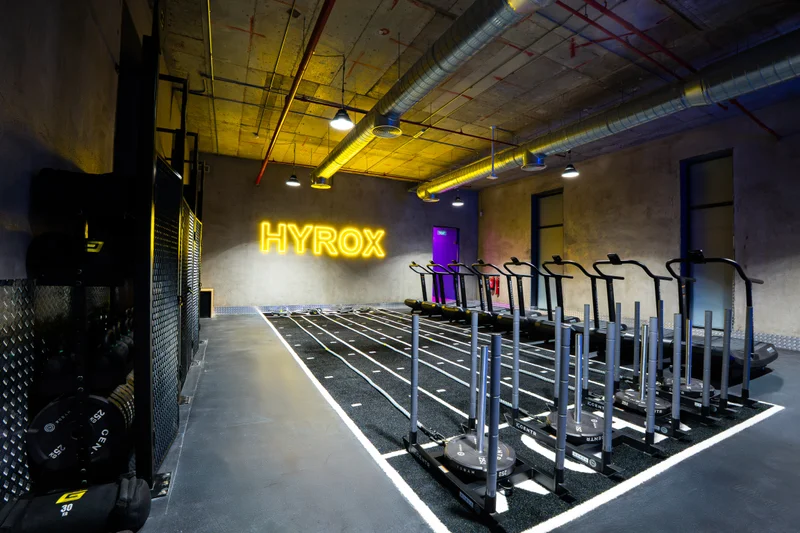












































Are you ready for HYROX? The full-body race explained

SIGN UP FOR YOUR FREE DAY PASS TODAY!
 WHATSAPP
 EMAIL
EMAIL
 SHARE VIA
HYROX looks simple on paper, then humbles you in practice. You run, you hit a brutal functional station, you run again, and your heart rate swings up and down the whole time. That contrast is exactly why it feels so intense, and why so many people get hooked.
At its core, HYROX is a standardised fitness race: eight 1km runs, each followed by one functional workout station, repeated eight times.
 Poll
PollYour ideal gym buddy is…
What makes HYROX different from “just running”?
Continuous running rewards steady rhythm. HYROX punishes anyone who only knows one gear.
Because you alternate between running and high-output work (think sleds, rowing, carries), your body has to:
-
recover quickly after spikes in effort
-
re-settle into a sustainable run pace
-
keep moving efficiently under fatigue
That “up-down” heart rate pattern trains your ability to adapt, which often carries over well to real-life fitness, not just the track.
The HYROX stations and why they feel full-body
HYROX stations are designed to hit multiple muscle groups at once. The exact list can vary by how it’s presented, but the commonly referenced sequence includes movements such as SkiErg, sled push, sled pull, burpee broad jumps, rowing, farmer’s carry, sandbag lunges and wall balls.
A simple way to think about the muscle demand:
-
Lower body: running, lunges, sled push, wall balls
-
Core: bracing during carries, pulling, lunges, wall balls
-
Upper body: rowing, sled pull, carries, wall balls
If you train HYROX properly, you’re not “doing cardio” or “doing weights”. You’re learning to combine them without falling apart.
Why HYROX builds endurance and metabolism differently
Switching between steady running and hard stations creates fluctuating demands on your system. That’s one reason it can have a meaningful impact on aerobic fitness markers like VO2 max, which is essentially your body’s capacity to use oxygen at high effort.
The practical takeaway: the fitter you get, the faster you recover between efforts, and the more consistent your output stays across the full race.
The biggest mistake: starting like it’s a 10-minute workout
Many strong, explosive athletes fly through the early stations and then crash because HYROX is a long effort (often 60–90 minutes, depending on level and division).
A better approach:
-
run the first kilometres slightly under control
-
treat the early stations as “efficient, not heroic”
-
aim to feel like you’re building into the second half, not surviving it
If you only remember one pacing rule: your fastest 5 minutes doesn’t matter if it ruins the next 55.
A simple HYROX readiness checklist
You’re in a good place to start specific prep if you can:
-
jog comfortably for 30–40 minutes (even if it’s slow)
-
perform lunges, squats and wall-ball patterns without knee/back pain
-
hold solid bracing (plank/anti-rotation control) under fatigue
-
recover your breathing within 60–90 seconds after hard intervals
If any of these are missing, you can still do HYROX. You just need a smarter build.
How to train for HYROX (without overcomplicating it)
Most people do best with 3–5 sessions per week, built around three pillars:
1) Build your running engine
You need both comfort and control.
-
1 easy run (steady, conversational)
-
1 quality session (intervals or tempo work)
-
optional short recovery run or incline walk
2) Strength that actually carries over to stations
Prioritise movements that support sleds, lunges, carries and wall balls:
-
squat pattern (front squat, goblet squat, leg press)
-
hinge pattern (RDLs, hip hinge work)
-
push/pull (rows, presses)
-
loaded carries
-
core bracing (anti-rotation, anti-extension)
3) HYROX-specific conditioning
1 session weekly where you practise “run + station” transitions:
-
1km run → 500m row → 1km run → farmer’s carry
Keep the goal as smooth output, not max effort.
If you want coaching and structured sessions, you can join HYROX classes at GymNation.
Fuel and recovery: the silent performance boosters
HYROX training is demanding. Under-fuelling is one of the fastest ways to stall progress.
-
Eat enough protein to support recovery
-
Don’t fear carbs if you’re running and doing high-intensity work
-
Sleep becomes non-negotiable as volume rises
To get a clear starting point for intake, use the Nutrition Calculator.
Source: Not provided
The opinions shared in the blog articles are solely those of the respective authors and may not represent the perspectives of GymNation or any member of the GymNation team.
Top 5 FAQs about HYROX


What is HYROX, exactly?
HYROX is a standardised fitness race that alternates 1km running with a functional workout station, repeated eight times.
Do I need to be a strong runner to do HYROX?
You need basic running fitness, but you don’t need elite speed. Consistency, pacing and the ability to keep moving under fatigue matter more.
Why does HYROX feel harder than a normal run?
Because stations spike your effort, then you have to run again while breathing hard. Your heart rate rises and falls repeatedly, which is very demanding.
What should I train first: strength or running?
If you’re new, build a base in both. Prioritise running consistency (so the 8km doesn’t crush you) and strength basics (so stations don’t break your form).
How long does a HYROX race take?
It varies by fitness level and division, but many athletes finish in roughly 60–90 minutes.
GET YOUR FREE TRIAL TODAY