

Lever Seated Leg Curl
Lever Seated Leg Curl Video Guide
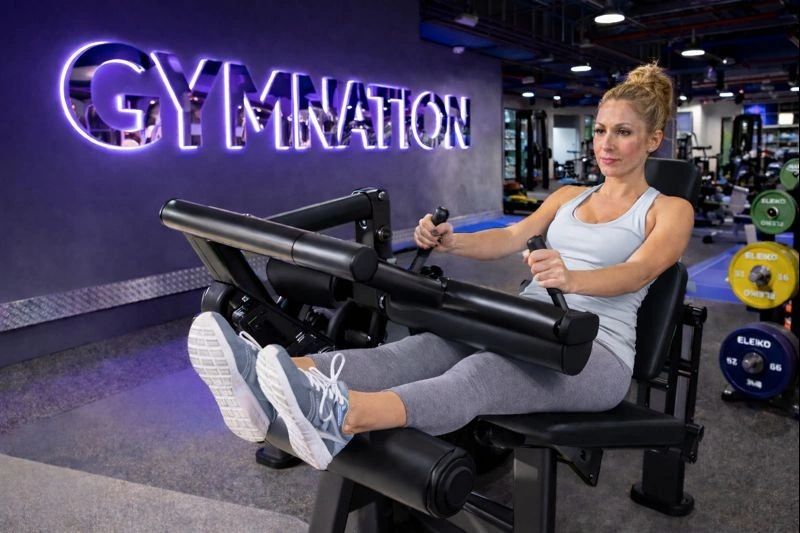
The Lever Seated Leg Curl is a seated leg curl variation that isolates all major hamstring muscles while keeping the torso supported in a stable starting position. The upright body position creates a strong straight line through the spine, allowing the leg curl machine to load the lower leg, thighs, and glutes with consistent tension. This exercise is ideal for improving knee stability, reducing common mistakes seen in prone leg curls, and strengthening the entire lower body through controlled hamstring curl mechanics.
How to Perform the Lever Seated Leg Curl
-
Sit on the leg curl machine, adjust the pad above your ankles, and set your feet and legs in the correct position.
-
Grip the handles, keep your torso and hips tight against the seat.
-
Curl the pad down using your hamstrings, keeping a smooth, stable movement.
-
Pause and squeeze your hamstring muscles, glutes, and calves at the bottom.
-
Slowly return to the starting position and repeat for the desired number of reps.
GymNation Tip: Lock your hips into the seat before you curl—if your hips slide forward, the tension leaves your hamstrings and the rep loses its bite.
Personal Trainer Notes:
-
Keep your back and butt firmly against the bench to maintain proper form.
-
Avoid jerking the weight — controlled motion activates more muscles.
-
Keep knees aligned; don’t let them flare during the curl.
-
Think “heels to glutes” with full control and stable breathing (inhale/exhale).
-
Excellent accessory exercise for knee health, posterior-chain balance, and reducing injury risk.
 WHATSAPP
 EMAIL
EMAIL
 SHARE VIA
Alternative Hamstring Exercises

Barbell Straight Leg Deadlift
The Barbell Straight Leg Deadlift targets the hamstrings and glutes through hip hinging. It’s ideal for building posterior chain strength and flexibility.

Reverse Sliding Leg Curl on Floor with Towel
The Reverse Sliding Leg Curl on Floor with Towel develops the hamstrings and glutes using bodyweight. It’s a low-impact exercise that challenges control and core stability.

Assisted Inverse Leg Curl
The Assisted Inverse Leg Curl strengthens the hamstrings and improves posterior chain control. Assistance allows for better form and eccentric strength development.

Cable Assisted Inverse Leg Curl
The Cable Assisted Inverse Leg Curl targets the hamstrings and glutes through an eccentric-focused movement. The cable assistance helps maintain control and build strength safely.

Trap Bar Deadlift
The Trap Bar Deadlift works the hamstrings, glutes, and lower back. It offers a joint-friendly alternative to traditional deadlifts with a more upright torso position.

Exercise Ball Leg Curl
The Exercise Ball Leg Curl targets the hamstrings and glutes while also engaging the core. It improves balance and coordination through instability training.

Nordic Hamstring Curl
The Nordic Hamstring Curl is a bodyweight exercise that develops eccentric hamstring strength, reducing injury risk and improving sprint performance.

Band Lying Leg Curl
The Band Lying Leg Curl strengthens the hamstrings using resistance bands. It’s perfect for home workouts or warm-ups before heavier leg training.

Lever Lying Leg Curl
The Lever Lying Leg Curl isolates the hamstrings (biceps femoris, semitendinosus, semimembranosus). It’s one of the most effective machine-based movements for building muscle and strength in the back of the thighs.
Lever Seated Leg Curl FAQs
The seated leg curl is ideal for isolating the hamstrings, strengthening the lower body, supporting the knee joint, and building stability in the hips. It offers a safer body position than the prone position and helps correct strength imbalances.
It targets the hamstring muscles (biceps femoris, semitendinosus, semimembranosus) with secondary tension on calves, glutes, and the quads. The fixed machine setup helps maintain alignment and reduces ligament strain.
Sit tall, keep your spine neutral, adjust the pad, brace the core, and curl the weight smoothly. Maintain full control and avoid letting the weight snap back.
Alternatives include hamstring curl variations such as the prone leg curl, resistance-band leg curls, stability-ball curls, or standing and single-leg options. These exercises also strengthen the hamstrings through knee flexion.