

Push-up for Ladies
Push-Up for Ladies Video Guide: Building Upper Body Strength
The push-up for ladies is a foundational body weight and strength training exercise used to build upper body strength while engaging the entire body. It primarily targets the chest muscles, shoulder muscles, and triceps, while the core, serratus anterior, hips, and stabilising muscles work together to keep the body in a straight line.
Unlike many gym-based exercises, push-ups can be performed at home with no equipment, making them an accessible and effective option for women at any fitness level.
As one of the most effective bodyweight exercises, push-ups help most women increase muscle mass, improve posture, and develop shoulder stability. Regular push-ups support functional fitness and overall health by building real-life strength for daily tasks such as lifting and carrying objects. Push-ups also contribute to burning calories, supporting fat loss when included in a structured exercise routine. When performed with proper form and a full range of motion, the standard push-up is a beneficial upper body exercise suitable for female beginners through advanced fitness levels.
How to Perform Push-Up for Ladies with Proper Form
-
Start on the floor with hands slightly wider than shoulders, supporting your body weight through the palms, knees, or toes. Keep the head, hips, and legs aligned in a straight line.
-
Set the shoulder blades down and back, brace the core, and maintain control of the rib cage.
-
Lower the body with control, bending the elbows to roughly 30–45 degrees while maintaining good form and shoulder alignment.
-
Pause briefly at the bottom with the chest close to the floor.
-
Push the body away by pressing through the hands and chest, returning to a strong lockout without losing form or control.
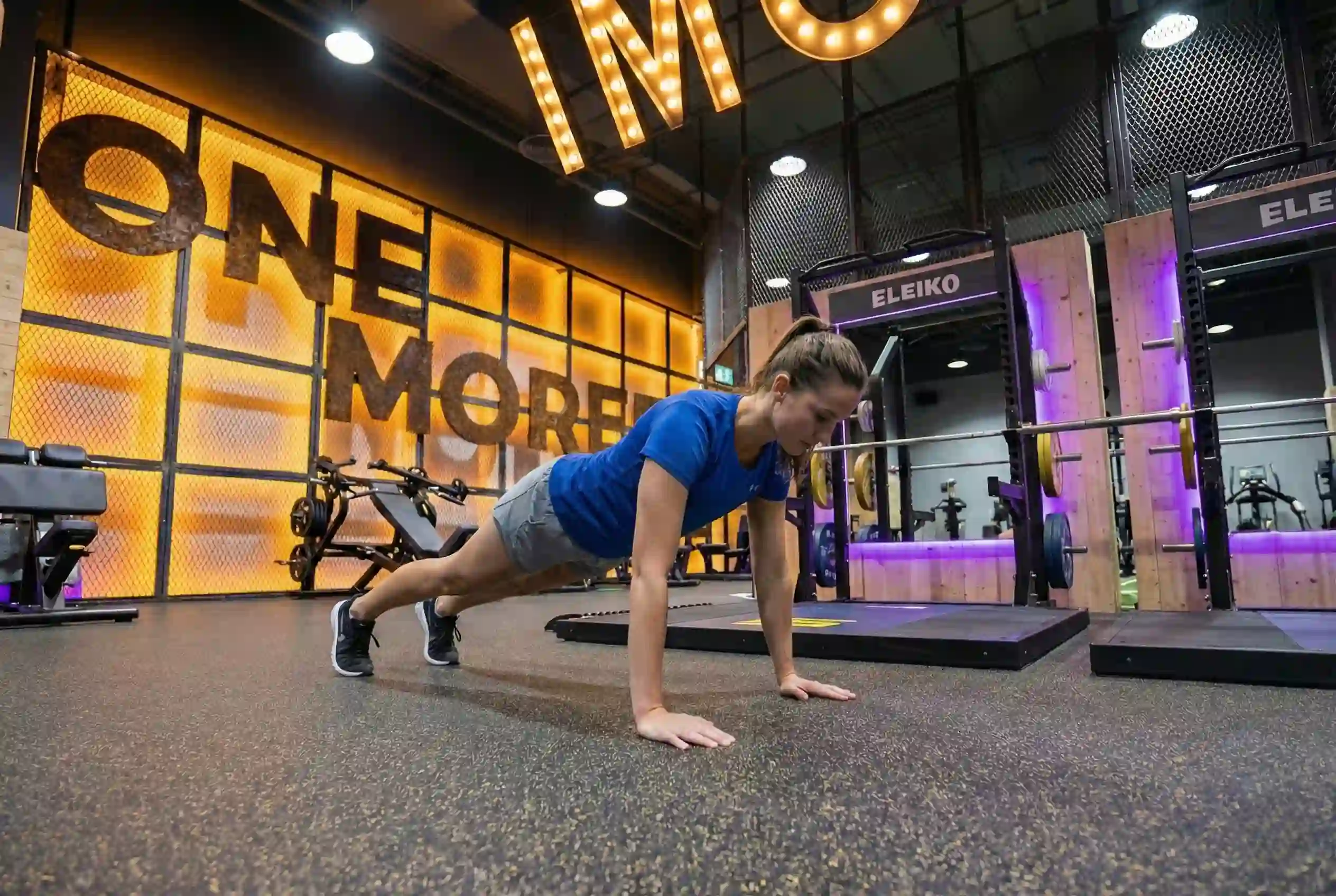
Personal Trainer Notes for Female Beginners:
-
Keep the entire body tight to improve stability and protect the shoulders.
-
Maintain shoulder blade control throughout each repetition.
-
Knee push-ups, incline push-ups, and wall push-ups are effective first exercises for female beginners.
-
Lower with control, then push powerfully while maintaining good form.
-
Take short breaks between sets to maintain technique.
-
Stop the set if form breaks — clean reps matter more than as many push ups as possible.
 WHATSAPP
 EMAIL
EMAIL
 SHARE VIA
Alternative Chest Exercises

Dumbbell Fly for Ladies
The dumbbell fly for ladies is a classic dumbbell chest exercise that targets the chest muscles (pecs) while engaging the arm muscles, shoulder region, and stabilising muscles of the upper body.

Dumbbell Bench Press for Ladies
The dumbbell bench press for ladies is a staple chest exercise used to build upper body strength and develop strong, balanced pressing mechanics.

Barbell Incline Bench Press for Ladies
The dumbbell incline bench press for ladies is a compound chest exercise that places greater emphasis on the upper chest muscles, especially the clavicular head of the pectoralis major.

Barbell Bench Press for Ladies
The barbell bench press for ladies is a foundational strength training exercise used to build upper body strength and increase muscle mass.

Dumbbell Incline Bench Press for Ladies
The Dumbbell Incline Bench Press for ladies is a dumbbell exercise that targets your pectorals. It also recruits the anterior deltoids and triceps to keep you stable and moving well from start to finish.

Dumbbell Decline Bench Press for Ladies
The Dumbbell Decline Bench Press for ladies is a dumbbell exercise that targets your pectorals. It also recruits the anterior deltoids and triceps to keep you stable and moving well from start to finish.

Barbell Decline Bench Press for Ladies
The Barbell Decline Bench Press for ladies is a barbell exercise that targets your pectorals. It also recruits the anterior deltoids and triceps to keep you stable and moving well from start to finish.

Dumbbell Incline Fly for Ladies
The Dumbbell Incline Fly for ladies is a dumbbell exercise that targets your pectorals. It also recruits the anterior deltoids and triceps to keep you stable and moving well from start to finish.
Push-up for Ladies FAQs
Yes. Push-ups are a highly beneficial upper body exercise for women. They strengthen the chest, shoulders, arms, triceps, and core while supporting better posture and confidence.
A proper push-up uses good form: hands slightly wider than shoulders, elbows controlled, core braced, hips level, and the body moving as one unit through a full range of motion.
This depends on fitness level. Female beginners may start with 5–10 knee or incline push-ups, while more experienced women often work toward 10–20 standard push-ups.
Yes. Both variations reduce load while reinforcing proper form and strength development, making them ideal for beginners.
Wall push-ups improve shoulder stability, upper body strength, and movement control, and are useful for beginners, rehabilitation, or low-intensity training.
Yes. Push-ups engage the chest, shoulders, arms, core, hips, and stabilising muscles, making them a full-body bodyweight exercise.
Yes. Push-ups strengthen the shoulder muscles and stabilisers around the shoulder blades, supporting improved posture and joint control.
Push-ups burn calories and help maintain muscle mass. When included in a balanced exercise routine with appropriate intensity and rest, they can support fat loss goals.
Push-ups require coordination, strength, and stability across multiple muscle groups. Early difficulty is a normal part of adaptation and progress.
After mastering the standard push-up, variations such as clap push-ups, tempo changes, incline progressions, or higher-intensity sets can be added.
Push-ups can be performed 2–4 times per week as part of a strength training or upper body workout routine, depending on recovery, fitness level, and goals.
Modified push-up variations, such as wall push-ups or incline push-ups, can help improve posture and reduce discomfort when performed with good form.
Yes. Balancing push-ups with pull exercises such as rows or pull-ups supports balanced strength development, joint health, and long-term progress.