


Cable Curl
Cable Curl Video Guide
The cable curl is a staple biceps exercise that uses the cable machine to deliver constant tension on the biceps brachii, brachialis, and brachioradialis forearm muscles throughout the entire movement. Unlike a barbell curl or dumbbell biceps curl, the cable bicep curl removes momentum and dead zones, making the curl harder at every point — especially when you slowly curl and slowly lower the weight through the full range.
Using different attachments such as a straight bar, EZ curl bar, rope, or single-hand cable attachment lets you switch between palms-up, neutral, and overhand positions without compromising proper form. This makes the cable curl one of the best biceps exercises for improving biceps muscle activation, fixing muscle imbalances, and maintaining cleaner elbow positioning. Because the load hits the upper arm at a slight angle, it enhances muscle growth, helps achieve a stronger mind–muscle connection, and improves control in the concentric and eccentric phases.
Whether your goal is arm shape, biceps brachii strength, forearm development, or a smoother curl compared to free weights, the cable biceps curl fits perfectly into any arms workout or upper-body strength routine.
How to Perform the Cable Curl
-
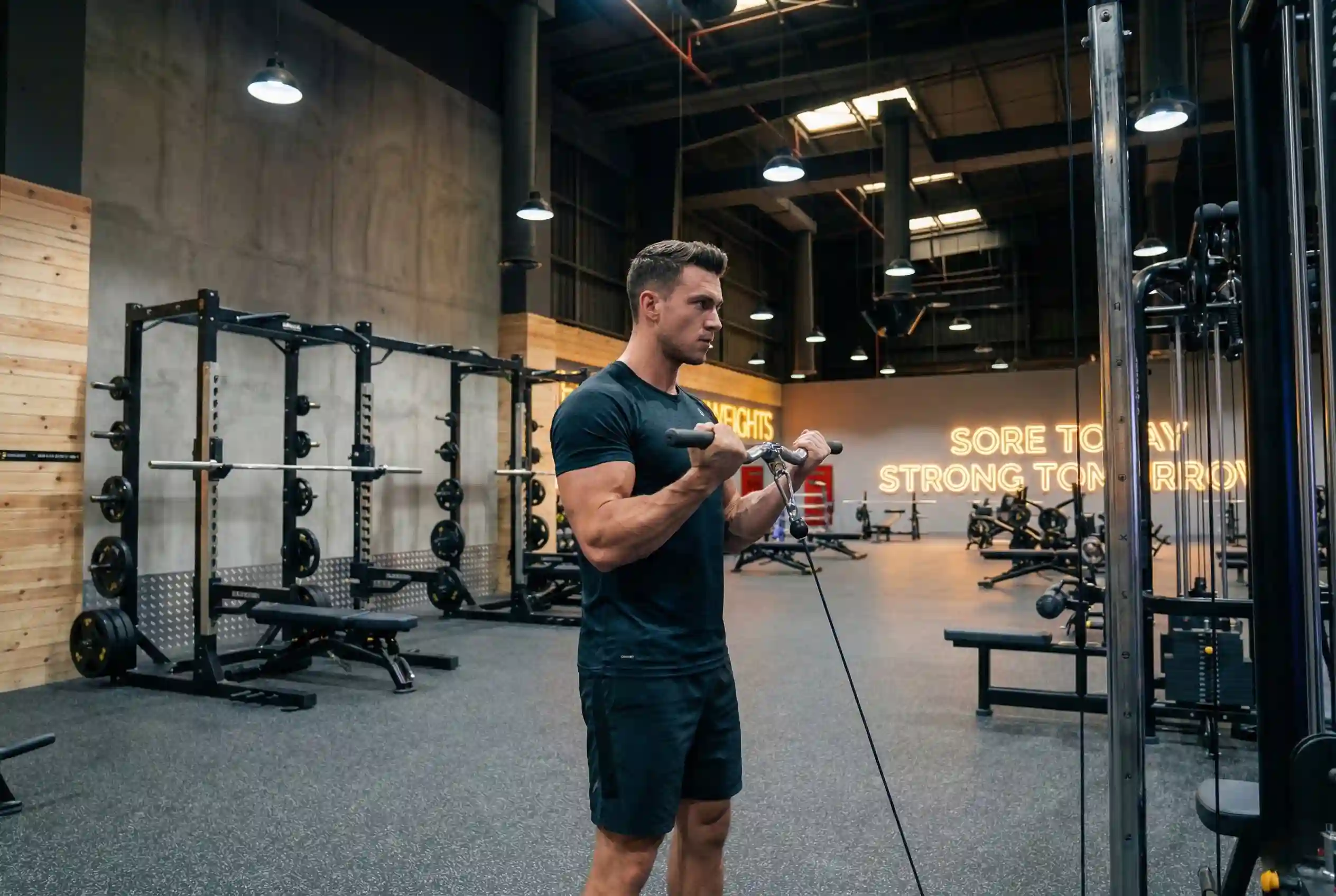
Set the starting position: Attach a straight bar or rope to the low pulley. Stand tall with feet shoulder-width apart, grab the attachment with an underhand palms-up position (or neutral for rope), and keep elbows close to your torso.
-
Keep the upper arms still, chest tall, shoulder blades set back, and core braced.
-
Curl the bar toward your chest using controlled elbow flexion, without rocking your torso or pulling with your shoulders.
-
Squeeze the biceps at the top of the rep, focusing on strong biceps activation.
-
Lower slowly through the eccentric phase, resisting the cable tension until your arms are almost straight. This lowered, lengthened position is where a significant portion of muscle growth occurs.
-
Repeat for clean, controlled reps without changing elbow angle or swinging the weight.
GymNation Tip: If your elbows drift forward, your wrists bend, or your torso leans back, the weight is too heavy. The goal is to keep tension constant, not chase heavy numbers.
Personal Trainer Notes:
-
Elbows stay fixed — drifting forward reduces tension on the biceps brachii.
-
Avoid leaning back; keep the torso locked in a neutral position.
-
Rope or single-arm variations increase forearm and grip engagement.
-
Keep wrists straight — bending them reduces effectiveness and strains the joint.
-
Exhale as you curl, inhale on the lowering phase.
-
The eccentric phase is where the cable curl shines — don’t rush it.
 WHATSAPP
 EMAIL
EMAIL
 SHARE VIA
Alternative Bicep Exercises

Dumbbell Hammer Curl
The Dumbbell Hammer Curl targets the biceps (brachialis) and forearms (brachioradialis). It builds both arm thickness and grip strength while reducing wrist strain.

Dumbbell Zottman Curl
The Dumbbell Zottman Curl targets both the biceps (biceps brachii) and forearms (brachioradialis) in one move. It builds balanced arm strength and control.

Dumbbell Incline Biceps Curl
The Dumbbell Incline Biceps Curl stretches and strengthens the biceps (biceps brachii) through a longer range of motion. It’s great for improving peak shape and flexibility.

Barbell Preacher Curl
The Barbell Preacher Curl isolates the biceps (biceps brachii) and reduces shoulder involvement, making it perfect for focused arm growth. The preacher bench supports strict form and control.

Dumbbell Concentration Curl
The Dumbbell Concentration Curl focuses on isolating the biceps (biceps brachii) for maximum contraction and shape. It’s excellent for building definition and mind-muscle connection.

Barbell Curl
The Barbell Curl targets the biceps brachii, helping to build size and strength in the front of your upper arms. It’s a staple for arm development and grip strength. Perform it with control and full range of motion for best results.

Dumbbell Standing Biceps Curl
The Dumbbell Standing Biceps Curl targets the biceps (biceps brachii) and forearms (brachioradialis). It helps improve arm symmetry and muscle tone when done with strict form.

Dumbbell Alternate Biceps Curl
The Dumbbell Alternate Biceps Curl strengthens the biceps (biceps brachii) while improving balance and coordination between arms. Alternating sides allows full focus on each arm.

EZ Barbell Curl
The EZ Barbell Curl strengthens the biceps (biceps brachii) with reduced wrist strain thanks to the angled grip. It’s ideal for building strength and muscle mass with comfort.
Cable Curl FAQs
The cable curl works the biceps brachii, brachialis, and forearm muscles with constant tension, making it one of the best isolation movements for improving arm shape and upper-arm strength.
Neither is “better,” but cable curls offer smoother tension and a more consistent load, while dumbbell curls allow freer movement. Using both creates more muscle balance.
Yes — the continuous tension and slow lowering phase make it excellent for muscle growth.
Stand tall, elbows tight, curl in a smooth line, squeeze at the top, and lower slowly with full control.
They’re different tools. Barbell curls allow heavy loading; cable biceps curls offer tension at every angle and reduce wrist strain.
Yes. The cable keeps the forearms and brachioradialis under tension, improving grip endurance and wrist stability.
Absolutely — the fixed path makes it beginner-friendly and easier to learn compared to free-weight curls.
Perform 3–4 sets of 10–12 controlled reps to maximise tension and growth.