
Cable Triceps Pushdown (V bar)
Cable Triceps Pushdown (V bar) Video Guide
The cable triceps pushdown (V bar) is a widely used tricep exercise performed on a cable pulley machine to build tricep strength, muscle growth, and control. While biceps often receive more attention, the triceps make up a larger portion of the upper arm and play a key role in pressing strength and upper-body performance. Using a V bar handle places the wrists in a neutral grip, which many lifters find more comfortable than a straight bar or rope attachment. This grip can reduce stress on the wrists and elbow joint while allowing many people to handle more weight for progressive overload.
The V bar tricep pushdown targets all three heads of the triceps brachii—the long head, lateral head, and medial head—with slightly greater emphasis on the lateral and medial heads due to the fixed hand position. Compared to rope attachment pushdowns, the V bar promotes a consistent bar path, stable upper arms, and controlled movement through the entire movement. While the difference between a V bar, rope, straight bar, or EZ bar may be subtle, rotating attachments can help train the triceps differently and manage joint stress over time. As an isolation exercise, tricep pushdowns are commonly included in arm workouts to improve muscle growth, definition, and upper-arm size. Strong triceps also support compound lifts such as bench press, overhead press, dips, and push ups, contributing to overall upper-body strength.
How to Perform the Cable Triceps Pushdown (V bar)
-
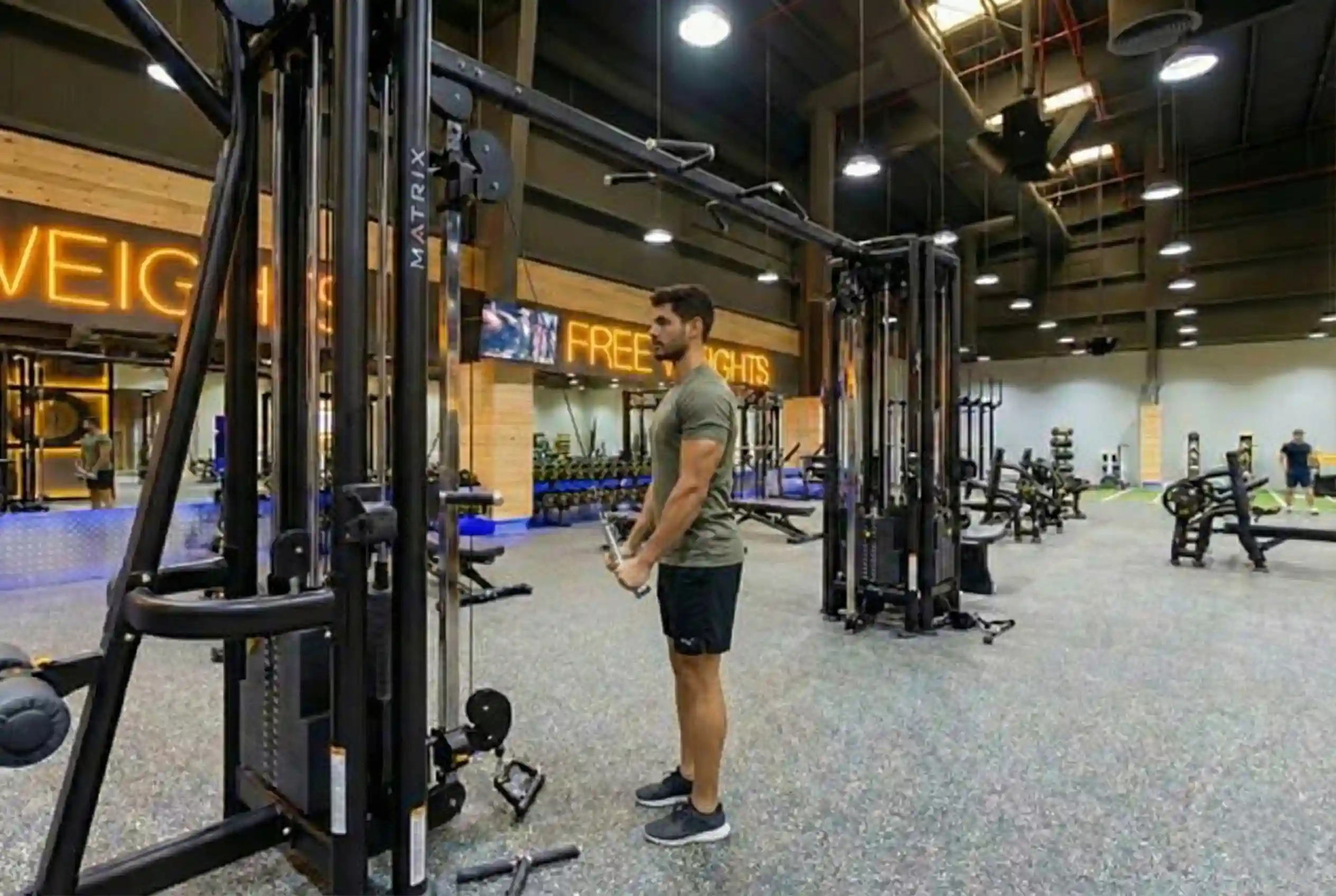
Attach a V bar handle to the high pulley of a cable machine and stand facing the stack. Take the starting position with feet shoulder-width apart, core braced, and torso upright.
-
Grab the V bar with a neutral grip (palms facing in), keep wrists straight, and tuck the elbows close to your sides. Set the shoulder blades down and back to stabilise the upper body.
-
Inhale, then push the bar down by extending the elbows until the arms are fully extended at the bottom of the movement.
-
Pause briefly at full extension and squeeze the tricep muscles to maximise activation.
-
Slowly return to the starting position with controlled motion, keeping the upper arms fixed and tension on the triceps throughout the entire movement.
GymNation Tip: Lock your elbows to your sides and drive the V bar straight down—if your shoulders move or the bar drifts forward, your triceps lose tension and the rep loses its purpose.
Personal Trainer Notes:
-
Keep elbows close to the body to maintain emphasis on the triceps and reduce shoulder involvement.
-
Use the neutral grip of the V bar to minimise wrist stress, especially when lifting heavier weight.
-
Control both the pushdown and the return to the starting position to reduce joint stress.
-
Avoid bending at the hips or using momentum to move the bar.
-
Exhale as you push down to reinforce controlled extension and core stability.
-
Stick with the attachment that feels most comfortable and effective for your training goals.
 WHATSAPP
 EMAIL
EMAIL
 SHARE VIA
Alternative Tricep Exercises

Barbell Lying Triceps Extension Skull Crusher
The Barbell Lying Triceps Extension, or Skull Crusher, isolates the triceps. It’s ideal for building size and strength in the back of the arms. Perform with control to protect your elbows.

Dumbbell Kickback
The Dumbbell Kickback isolates the triceps and develops control and definition. It’s ideal for finishing a triceps workout with focused tension and stability.

Cable Pushdown
The Cable Pushdown is a classic triceps builder that develops all three heads evenly. It’s perfect for strength, tone, and control.

Cable Overhead Triceps Extension (Rope Attachment)
The Cable Overhead Triceps Extension (rope attachment) targets the long head of the triceps for shape and definition. The cable keeps tension constant through the entire movement.

Cable Pushdown (Rope Attachment)
The Cable Pushdown (with rope attachment) isolates the triceps, improving definition and endurance. The rope allows a natural wrist rotation for a stronger contraction at the bottom.

Barbell Standing Overhead Triceps Extension
The Barbell Standing Overhead Triceps Extension builds power in the long head of the triceps and engages the core for stability. Standing version allows heavier loading and overall strength development.

Barbell Seated Overhead Triceps Extension
The Barbell Seated Overhead Triceps Extension strengthens the long head of the triceps, improving upper-arm size and shoulder stability. Performing it seated enhances control and posture.

Dumbbell Standing Triceps Extension
The Dumbbell Standing Triceps Extension builds strength and stability through the long head of the triceps. Standing position engages the core and improves control.

Barbell Close Grip Bench Press
The Barbell Close Grip Bench Press targets the triceps (triceps brachii) while engaging the chest (pectorals) and shoulders (anterior deltoids). It’s an excellent compound exercise for building pressing power and arm definition.
Cable Triceps Pushdown (V bar) FAQs
Both are effective for achieving more activation of the triceps . A rope attachment allows a greater range of motion and a stronger squeeze at the bottom, while a V bar or straight bar allows heavier weight, stability, and consistent tension.
Yes. The V bar is joint-friendly, supports heavier loading, and helps keep elbows tucked, making it effective for building tricep strength and size.
It targets the triceps brachii, including the long head, lateral head, and medial head. The forearms assist for grip stability.
For many lifters, yes. The neutral grip of the V bar often places less stress on the wrists than a fully pronated grip, highlighting the difference in comfort levels for lifters .
A neutral grip with the V bar is most common as it is friendly to the shoulder joint . Underhand or supinated grips can shift more emphasis to the long head but may increase wrist stress.
Most people train tricep pushdowns in the 8–15 rep range for hypertrophy to track their progress , focusing on controlled reps and full extension.
Yes. Stronger triceps from pushdowns can improve pressing performance in bench press, overhead press, dips, and push ups, but also enhance the ability to pull during other lift .
Tricep pushdowns train the triceps on the back of the arm, while bicep curls target the biceps on the front. Including both supports balanced arm strength, muscle growth, and joint health.