

Dumbbell Step-up
Dumbbell Step-up Video Guide
The Dumbbell Step-up is a powerful unilateral exercise that builds lower body strength, improves balance, and enhances glute activation. Stepping onto a bench or plyo box with proper form targets the glutes (gluteus maximus), quads, hamstrings, and core muscles while reducing muscle imbalances. Because step ups mimic everyday activities, they’re a great alternative to barbell step ups or weighted step ups for building strength, stability, and functional movement. When performed correctly, the dumbbell step up also challenges the posterior chain, hip flexors, and abdominal muscles, helping create better coordination and athletic performance.
How to Perform the Dumbbell Step-up
-
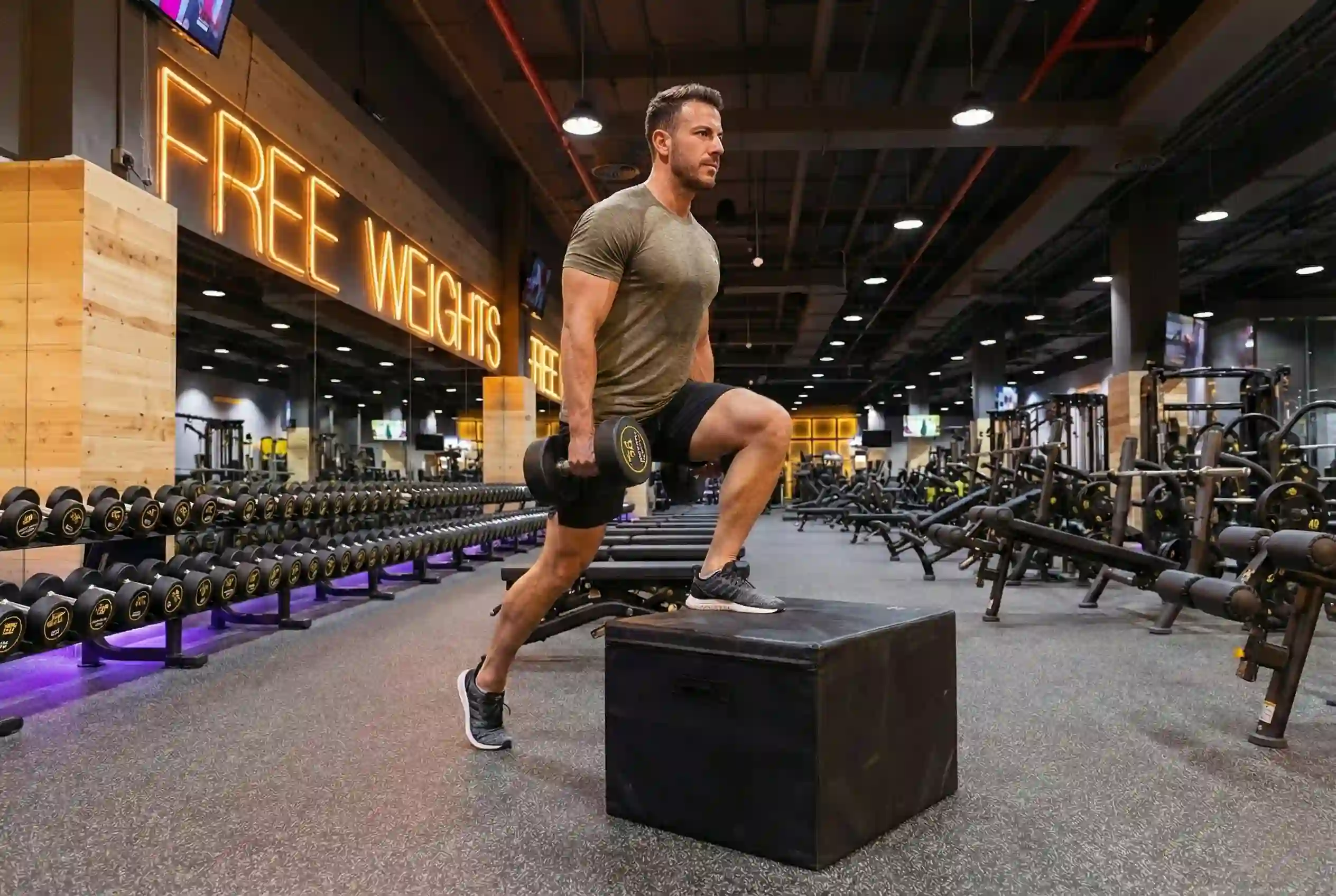
Stand facing a stable bench or plyo box with dumbbells held at shoulder height or by your sides in the starting position.
-
Place your left foot firmly on the bench and lean forward slightly to engage the working leg.
-
Press through your heel and step up, lifting your body with controlled movement.
-
Bring the right foot up to meet it, standing tall through the torso.
-
Step back down slowly, keeping tension on the glutes and hamstrings.
-
Repeat all reps on one leg before switching sides to balance muscle mass and control.
GymNation Tip: Drive through the heel of your stepping leg—not the toes—and keep your chest tall to maximise glute activation and avoid leaning forward.
Personal Trainer Notes:
-
Keep your core muscles tight to improve core strength and stability.
-
Avoid using momentum — each rep should be a controlled movement.
-
Focus on glute activation by pushing through the heel of the working leg.
-
Do not let the knee collapse inward; track the toes.
-
Choose a height that allows a full range without sacrificing proper technique.
 WHATSAPP
 EMAIL
EMAIL
 SHARE VIA
Alternative Glute Exercises

Landmine Rear Lunge
The Landmine Rear Lunge targets the glutes (gluteus maximus) and hamstrings while improving coordination and core stability. The landmine setup adds support for controlled motion.

Barbell Curtsey Lunge
The Barbell Curtsey Lunge works the glutes (gluteus medius and maximus) and inner thighs. The crossing movement improves hip stability and overall lower-body balance.

Dumbbell Bulgarian Split Squat
The Dumbbell Bulgarian Split Squat targets the glutes (gluteus maximus), hamstrings, and quads. Elevating the rear foot increases the range of motion and intensity on the working leg.

Barbell Lunge
The Barbell Lunge builds strength in the glutes (gluteus maximus), quads, and hamstrings. It’s a key movement for balance, coordination, and full lower-body power.

Barbell Full Squat
The Barbell Full Squat targets the glutes (gluteus maximus), quads, and hamstrings. It’s a compound lift that builds total lower-body strength and power.

Dumbbell Single Leg Split Squat
The Dumbbell Single Leg Split Squat strengthens the glutes (gluteus maximus), quads, and hamstrings while enhancing balance and stability. It’s ideal for unilateral strength and correcting imbalances.

Kettlebell Split Squat
The Kettlebell Split Squat strengthens the glutes (gluteus maximus), quads, and hamstrings. It’s a stable, beginner-friendly way to develop single-leg strength and balance.

Dumbbell Rear Lunge
The Dumbbell Rear Lunge targets the glutes (gluteus maximus) and hamstrings, placing less stress on the knees than a forward lunge. It’s great for improving hip stability and strength.

Dumbbell Lunge
The Dumbbell Lunge works the glutes (gluteus maximus), quadriceps, and hamstrings. It’s excellent for building leg strength, balance, and coordination while improving lower-body symmetry.
Dumbbell Step-up FAQs
Dumbbell step ups build lower body strength, improve balance, and strengthen key muscles worked — glutes, quads, hamstrings, calves, and core. Because they’re unilateral exercises, they also reduce muscle imbalances and boost athletic performance.
Yes. Step ups work the glutes intensely, especially when driving through the heel and using enough weight to challenge the working leg. They also develop hip stability and are excellent for building explosive power.
Not better — just different. Squats are superior for total muscle mass and bilateral strength, while dumbbell step ups excel at single-leg stability, coordination, and glute-focused training. Many programmes use both for a complete strength training routine.
Choose a height where your hip and knee bend to roughly 90 degrees. Higher benches increase difficulty, require more mobility, and help build explosive power, but must be performed with strict proper form.
Yes. They’re a great alternative for beginners or home training setups and offer many of the same benefits without needing a squat rack or barbell. They allow safer progression and are easier to perform with just the bar, dumbbells, or a single kettlebell.