


Cable Incline Fly on Stability Ball
Cable Incline Fly (on Stability Ball) Video Guide
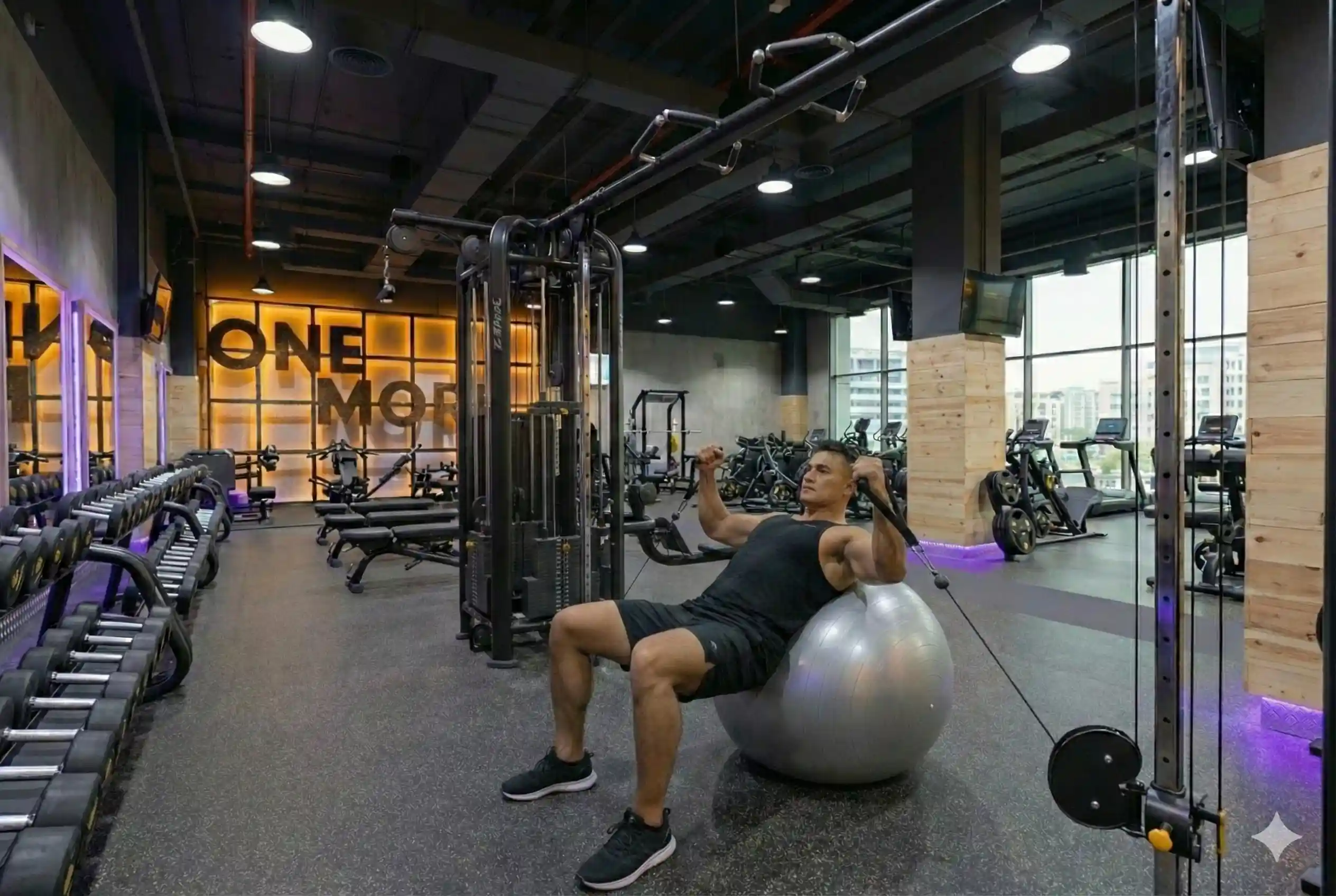
The cable incline fly on a stability ball is an upper-chest isolation exercise that primarily targets the clavicular head of the pectoralis major. Using a cable machine and stability ball instead of a traditional incline bench creates a slightly inclined torso position while adding a significant stability and core challenge.
Unlike cable presses or bench press variations, this movement focuses on chest adduction rather than elbow extension. The cable pulley machine provides constant tension throughout the entire range of motion, improving muscle activation at both the stretched and contracted positions. This makes the cable incline fly especially effective for hypertrophy-focused chest training and developing control in the upper chest muscles.
Secondary muscles include the anterior deltoids, biceps brachii (as stabilisers), and core musculature. Performing the exercise on a stability ball increases activation of the abdominals, glutes, and hips, as the body must stabilise throughout the fly movement. Compared to free weights, cable machine exercises allow smoother resistance and more consistent tension, which can reduce stress on the shoulder joint when proper form is maintained.
The cable incline fly on a stability ball is well suited for chest workouts focused on muscle growth, shoulder-friendly isolation work, and improving coordination. It can be used as a primary upper-chest movement or as a finishing exercise after pressing patterns.
How to Perform the Cable Incline Fly (on Stability Ball):
-
Set both cable pulleys slightly below shoulder height on a cable pulley machine and attach a single handle attachment to each side. You will be using two cables for this exercise. Place a stability ball between the cables.
-
Sit on the stability ball and walk your feet forward until your upper back and shoulders rest on the ball, creating a slight incline through the torso. Keep the hips lifted, core tight, and feet planted shoulder-width apart. A staggered stance with one leg stepping forward can help with balance and stability.
-
Grab the cable handles with palms facing inward. For example, your right hand should grip the handle firmly. Bring the arms out to the sides at chest height, setting the starting position with arms extended and elbows slightly bent. Pull the shoulder blades down and back to stabilise the shoulders.
-
Inhale and bring the arms forward and slightly upward in a controlled arc, maintaining the elbows slightly bent and keeping tension on the chest muscles. Focus on bringing the hands together in front of the chest while squeezing the upper chest. Perform controlled movements throughout the entire range of motion, following a specific line to target the upper chest.
-
Pause briefly at the top, then slowly release the arms back to the starting position under control, maintaining constant tension throughout the movement.
GymNation Tips: Performing the cable incline fly on a stability ball provides a greater challenge for your core and stabiliser muscles compared to a bench. Also, personal preferences, such as stance or cable height, can be adjusted for comfort and to focus on specific muscle areas.
Personal Trainer Notes:
-
Maintain a slight bend in the elbows to protect the shoulder joints
-
Keep shoulder blades retracted throughout the entire movement
-
Use lighter weight to improve control and muscle activation
-
Avoid turning the fly into a press
-
Keep the core tight to prevent hips from dropping on the stability ball
-
Slow eccentrics increase time under tension and chest engagement
-
Hand position, stance, and cable height can be adjusted based on personal preference and comfort
 WHATSAPP
 EMAIL
EMAIL
 SHARE VIA
Alternative Chest Exercises

Cable Bench Press
The Cable Bench Press is a cable exercise that targets your pectorals. It also recruits the anterior deltoids and triceps to keep you stable and moving well from start to finish.

Push-up
The Push-up is a bodyweight exercise that builds strength in the chest (pectorals), shoulders (deltoids), arms (triceps), and core (abdominals).

Cable Standing Fly
The cable standing fly is a highly effective chest exercise that isolates the chest muscles using constant tension from the cable machine.

Barbell Wide Bench Press
The Barbell Wide Bench Press is a barbell exercise that targets your pectorals. It also recruits the anterior deltoids and triceps to keep you stable and moving well from start to finish.

Cable Decline Fly
The Cable Decline Fly is a cable exercise that targets your pectorals. It also recruits the anterior deltoids and triceps to keep you stable and moving well from start to finish.

Chest Dip
The chest dip is one of the most effective upper-body body-weight exercises for building the chest muscles,

Barbell Decline Wide Grip Press
The Barbell Decline Wide Grip Press is a barbell exercise that targets your pectorals. It also recruits the anterior deltoids and triceps to keep you stable and moving well from start to finish.

Cable Crossover Variation
The Cable Crossover Variation is a cable exercise that targets your pectorals. It also recruits the anterior deltoids and triceps to keep you stable and moving well from start to finish.
Cable Incline Fly (on Stability Ball) FAQs
The incline cable fly primarily targets the upper chest, specifically the clavicular head of the pectoralis major. Secondary muscles include the anterior deltoids, biceps (as stabilisers), and core—especially when performed on a stability ball.
Yes. Incline flyes are one of the most effective isolation movements for upper chest development when performed with controlled movement and a full range of motion.
Around 20–30 degrees. This angle maximises upper-chest activation while limiting excessive shoulder involvement.
Thirty degrees is generally better. At 45 degrees, the front delts tend to dominate, reducing chest emphasis.
Neither is better overall. Incline flyes emphasise the upper chest, while flat flyes target the mid-chest. Using both supports balanced chest development.
Using too much weight, excessive elbow bend or locking out, losing shoulder blade control, turning the movement into a press, and rushing the eccentric phase.
A small, natural arch is fine. Excessive arching usually indicates the load is too heavy or core stability is lacking—especially on a stability ball.
Incline movements don’t grow the entire chest more, but they are particularly effective for developing the upper chest, which many lifters under-train.
Cable flyes, often called cable chest fly variations, provide constant tension and smoother resistance, while dumbbell flyes offer a deeper stretch but less tension at the top. Many users find cable flyes less stressful on the shoulder joints compared to dumbbell flyes. The cable chest press is a compound movement that activates the pectorals, anterior deltoid, and triceps, similar to the barbell bench press, whereas flyes isolate the chest more directly.
Incline cable flyes target the upper chest, mid-level cable chest fly variations emphasise the middle chest, and high-to-low cable fly variations place more emphasis on the lower chest. Adjusting the cable height and angle allows you to target different parts of the chest for comprehensive pectoral development.
To perform incline cable flyes, use two cables on a cable pulley machine, each fitted with a single handle attachment. Set the cables at a low position, grab a handle in each hand, and lie back on a stability ball or incline bench. This setup ensures proper resistance and muscle engagement, and using a stability ball also increases core activation and allows for a more natural range of motion.
General flat bench standards:
-
Beginner: 50–70 kg
-
Intermediate: 80–100 kg
-
Advanced: 110 kg+
Fly movements use much lighter loads and are not directly comparable.