


Barbell Wide Bench Press
Barbell Wide Bench Press Video Guide
The barbell wide bench press is a bench press variation designed to place greater emphasis on the chest muscles, particularly the pectoralis major. Performed on a flat bench, it is a form of barbell bench press that shifts load away from the triceps and onto the chest by using a wide grip that is wider than shoulder width. Grip width directly affects which muscle groups are targeted and how the weight is distributed during the lift, making it a key factor in optimizing muscle activation and load management. As with other bench press grip options, choosing the best bench press grip depends on training goals, joint comfort, and experience level.
Compared to a traditional bench press or close grip bench press, the wide grip bench press increases chest activation while reducing triceps involvement. The wide-grip bench press reduces triceps and deltoid involvement, forcing the chest muscles to work harder during the lift. The anterior deltoids assist as secondary muscles, helping stabilise the upper arms and shoulder joint. Because the grip shortens the range of motion, many lifters can move heavier weights, but this also increases stress at the shoulders and requires strict proper form to avoid injury. Using a wide grip allows you to lift more weight and can be effective for upper body strength, but a wide grip bench press can lead to increased torque on the shoulder joint, posing an injury risk for lifters with a history of shoulder injuries. The torque in the shoulders is nearly 1.5 times greater when performing a wide-grip bench press than a narrow-grip one, increasing injury potential. Some individuals may experience shoulder instability and pectoralis major rupture when performing the wide-grip bench press. Excessively wide grips may raise the risk of shoulder discomfort, muscle imbalances, or strain if mobility or control is lacking.
When performed correctly, the barbell wide bench press is a valuable chest press for hypertrophy-focused training, improving chest width, muscle stretch, and overall chest development. The unique benefits of the wide grip bench press include enhanced chest activation and the potential to address muscle imbalances by increasing the range of motion for the chest. This variation also involves the latissimus dorsi, sternal head, and clavicular head of the pectoralis major, contributing to comprehensive upper body development. Compared to a narrow grip, which increases triceps activation and range of motion, the wide grip—especially when combined with different bench angles—alters muscle activation and biomechanics, allowing you to tailor the angle and bench angle for specific training outcomes. While it can contribute to strength gains, it is generally better suited to experienced lifters who already have good control in the barbell bench press, flat bench press, and other bench press variations.
How to Perform the Barbell Wide Bench Press:
-
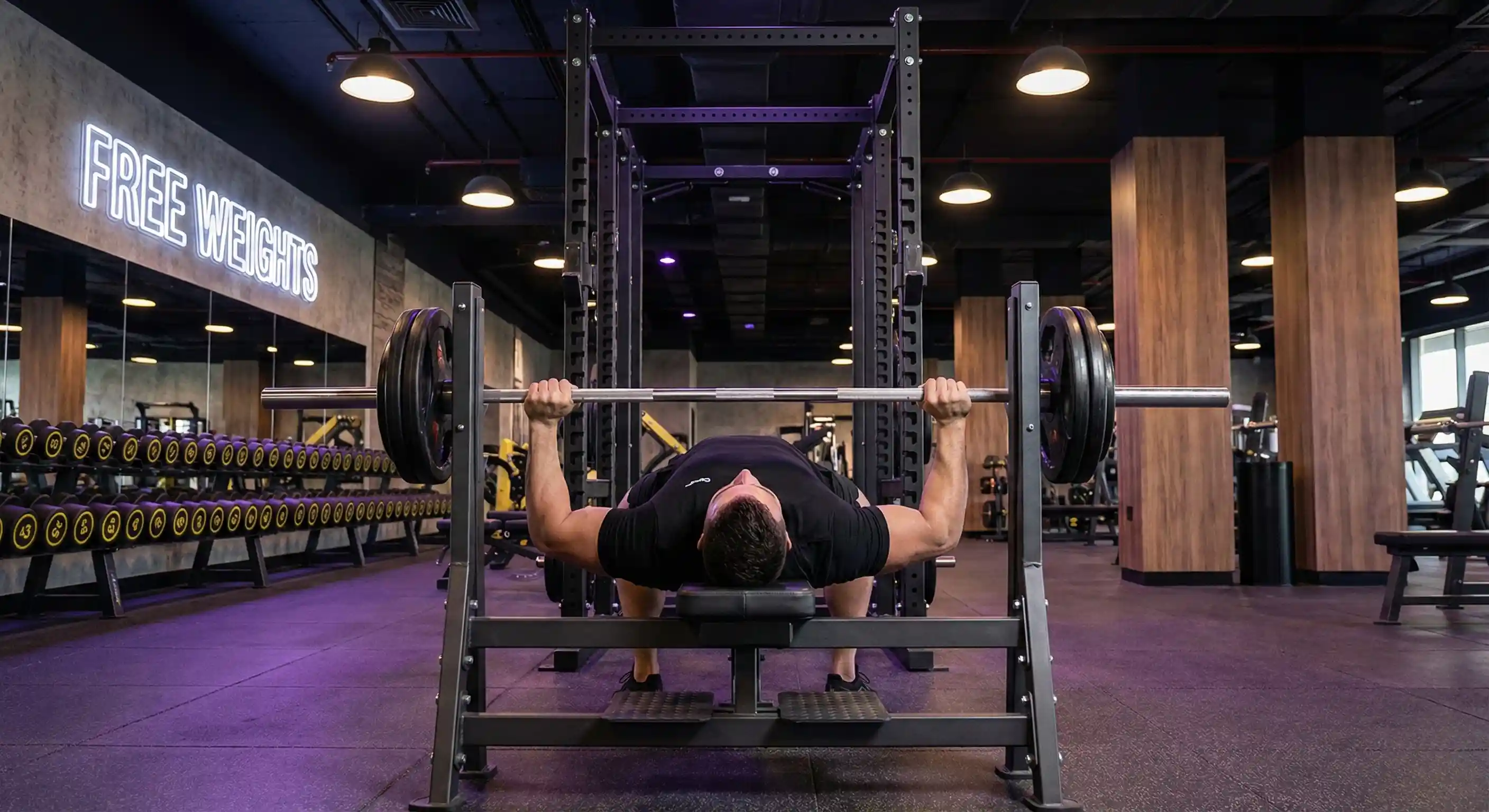
The barbell wide bench press is an effective exercise for building upper body strength and muscle mass. Lie flat on a bench with your feet firmly planted on the floor. Maintain whole-body rigidity by digging your feet into the floor, squeezing your glutes, flexing your midsection, and driving your shoulder blades into the bench. Set up beneath the rack and retract your shoulder blades down and back. Drive your shoulders back and down towards your bum before un-racking the bar from the bench press rack. Grip the barbell with hands positioned slightly wider than shoulder width, then securely grab and unrack the bar to the starting position with the arms fully extended over the chest.
-
Maintain full-body tension by driving the feet into the floor, keeping the torso stable, and stacking the wrists over the elbows. Keep the chest lifted and shoulders packed throughout the movement.
-
Inhale and slowly lower the barbell to nipple level to avoid flaring your elbows, which increases the risk of shoulder injury. Control the descent and keep the bar path consistent. Avoid excessive elbow flare and do not bounce the bar off the chest, as this reduces muscle activity and increases injury risk.
-
Pause briefly just above the chest to maintain tension and stability. Exhale and push the bar upward by extending the arms back to the top position, keeping control through the entire movement. Another common error is shortening the range of motion by lifting too much weight, which leads to not fully extending your elbows at the top of the repetition.
-
Repeat for the desired number of reps, then carefully return the bar to the rack. A spotter is essential for safety when performing a wide grip bench press, especially with heavy weight.
Personal Trainer Notes:
-
Use a grip wider than shoulder width, but avoid excessively wide hand placement
-
Keep shoulder blades retracted to protect the shoulders and improve stability
-
Control the descent to maximise chest activation and reduce injury risk
-
Avoid excessive elbow flare or unstable elbows
-
Use a spotter or safety pins when lifting heavier weights
Variations and Tips:
-
Adjusting the bench angle (flat, incline, or decline) changes muscle activation and the focus of the exercise. Incline targets the upper chest, while decline emphasizes the lower chest.
-
Using a narrow grip or performing a narrow grip bench press (hands closer together) shifts emphasis to the triceps, increases range of motion, and reduces shoulder stress. For this variation, keep your elbows tucked to enhance shoulder stability and reduce strain.
-
The reverse grip bench press (palms facing up) is another variation that increases biceps involvement and can be useful for specific training or rehabilitation needs.
-
Always grab the bar securely and, when lifting heavy, grab a spotter for added safety.

 WHATSAPP
 EMAIL
EMAIL
 SHARE VIA
Alternative Chest Exercises

Dumbbell Incline Fly
The Dumbbell Incline Fly isolates the upper chest (clavicular pectorals) with support from the shoulders (anterior deltoids). It enhances muscle definition and helps develop upper chest control.

Dumbbell Incline Bench Press
The Dumbbell Incline Bench Press works the upper chest (clavicular pectorals), shoulders (anterior deltoids), and triceps. It helps improve upper chest definition and balance between sides while building pressing power.

Barbell Incline Bench Press
The Barbell Incline Bench Press targets the upper chest (clavicular pectorals) and front shoulders (anterior deltoids), with support from the triceps. It’s ideal for developing shape and definition across the upper chest.

Barbell Decline Bench Press
The Barbell Decline Bench Press targets the lower chest (lower pectorals) while also engaging the triceps and shoulders (anterior deltoids). The decline angle reduces shoulder strain and shifts more load to the lower pec fibres.

Smith Bench Press
The Smith Bench Press is a smith machine exercise that targets your pectorals. It also recruits the anterior deltoids and triceps to keep you stable and moving well from start to finish.

Incline Push-up
The Incline Push-Up is a bodyweight exercise that targets your pectorals. It also recruits the anterior deltoids and triceps to keep you stable and moving well from start to finish.

Decline Push-Up
The Decline Push-Up is a bodyweight exercise that targets your pectorals. It also recruits the anterior deltoids and triceps to keep you stable and moving well from start to finish.

Cable Middle Fly
The Cable Middle Fly is a cable exercise that targets your pectorals. It also recruits the anterior deltoids and triceps to keep you stable and moving well from start to finish.
Barbell Wide Bench Press FAQs
The wide grip bench press primarily targets the chest muscles (pectoralis major). Among the muscle groups involved, the anterior deltoids assist, while triceps involvement is reduced compared to narrower grips.
Benefits include greater chest emphasis, improved chest width, strong muscle stretch, and suitability for hypertrophy-focused chest training.
Potential drawbacks include increased shoulder stress if form or mobility is poor, a shorter range of motion, and reduced triceps carryover.
A wide grip reduces triceps contribution and increases chest stretch and shoulder stability demands, which commonly results in lighter loads than a traditional bench press.
A common guideline is hands positioned around 1.5–2× shoulder width, with forearms roughly vertical at the bottom of the lift. Extremely wide grips increase injury risk without clear benefit.
The wide grip bench press emphasises the chest, while the close grip bench press shifts focus to triceps strength. The close grip uses a greater range of motion, while the wide grip allows heavier weights due to a shorter range. The narrow grip bench press, which uses a reduced grip width, targets different muscle groups by increasing triceps activation and reducing chest involvement compared to a wide grip.
It is generally better suited to experienced lifters. Beginners should prioritise mastering the flat bench press and traditional barbell bench press first.
On a flat bench, the wide grip primarily targets the mid-to-lower chest rather than the upper chest.