
Cable Middle Fly
Cable Middle Fly Video Guide
The cable middle fly is a chest isolation exercise performed on a cable machine using two cables set at chest height. This variation primarily targets the mid-chest, specifically the sternal head of the pectoralis major, by emphasising horizontal arm adduction through a controlled fly motion. Unlike pressing exercises, the cable middle fly focuses on bringing the arms forward rather than extending the elbows; this exercise takes a unique approach compared to pressing movements, making it ideal for hypertrophy and chest shaping.
Because cables provide constant tension throughout the entire range of motion, the cable chest fly keeps the chest muscles engaged from the stretched position to peak contraction. Cable fly exercises can provide a greater challenge than dumbbell flyes due to the constant tension from the cables. This makes the cable middle fly especially effective for improving chest thickness, muscle control, and mind–muscle connection. The resistance curve of the cable machine also reduces momentum compared to free weights, helping maintain tension where it matters most.
When setting up, verify that both handles are securely attached before starting the exercise. Gripping the handles firmly is important to maintain control and proper form throughout the movement. Adjusting the cable height can also help target different regions of the chest; setting the cables slightly lower can emphasize the lower portion of the chest muscles.
Secondary muscles include the anterior deltoids and biceps, which act as stabilisers, along with the core, which helps maintain body position during the movement. When performed with a slight bend in the elbows, proper shoulder blade positioning, and controlled tempo, the cable middle fly is relatively joint-friendly and places minimal stress on the shoulder joints. Keeping elbows straight can place excessive stress on the biceps and shoulder joints.
The cable middle fly is commonly used as a main isolation movement or finishing exercise in chest workouts. It pairs well with flat and incline pressing movements to ensure balanced chest development across all regions of the chest.
How to Perform the Cable Middle Fly:
-
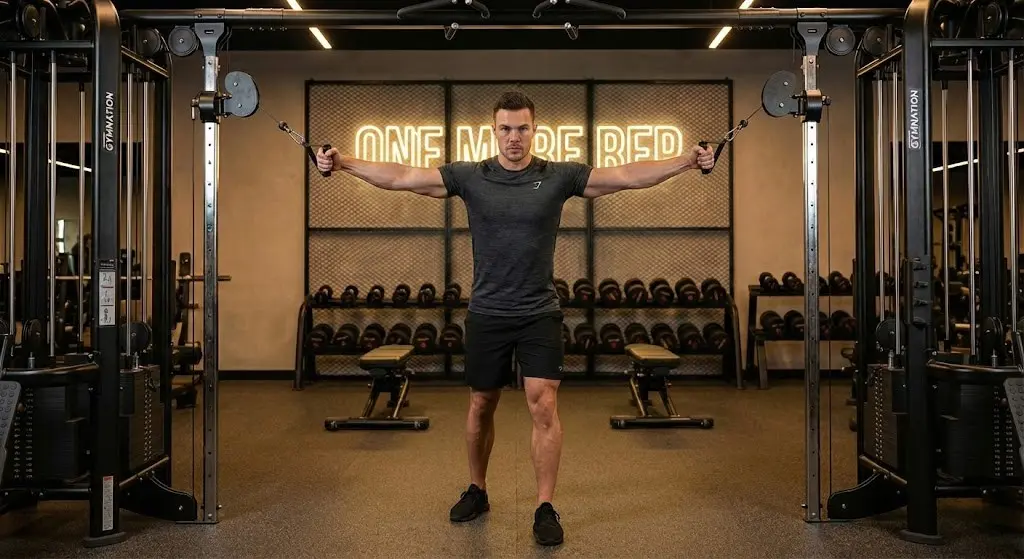
Set both pulleys on the cable machine to chest height and attach a handle to each cable. Stand centred between the stacks and take a small step forward with one foot to create a stable split stance. Keep the chest tall, core engaged, and body upright.
-
Grab the handles with palms facing forward or slightly inward. Extend the arms out to the sides at chest height with the arms extended but elbows slightly bent. This elbow position should stay consistent throughout the movement.
-
Pull the shoulder blades down and back to stabilise the shoulder joints. Keep the head neutral, chest lifted, and avoid leaning or shifting weight during the set.
-
Inhale and bring your arms forward in a wide, controlled arc, focusing on bringing your arms together by moving the hands toward each other rather than pressing the weight. Maintain constant tension through the chest as the cables move.
-
When the hands come together in front of the chest, pause briefly and squeeze the chest muscles. The handles should meet at mid-chest height without crossing. Avoid allowing the weights to crash together at the end of the movement, as this removes tension from the muscle.
-
Slowly return the arms back to the starting position under control, keeping tension on the chest and maintaining the same elbow bend. Use a slow and controlled motion on the negative phase to ensure the chest controls the return of the weight. Repeat for smooth, even repetitions through the full range of motion.
Personal Trainer Notes:
-
Keep palms facing consistently to maintain chest emphasis
-
Maintain a slight bend in the elbows throughout
-
Avoid turning the fly into a press
-
Use moderate weight to preserve control and tension
-
Focus on slow eccentrics for better muscle engagement
-
Keep the movement level—do not raise or drop the arms
 WHATSAPP
 EMAIL
EMAIL
 SHARE VIA
Alternative Chest Exercises

Dumbbell Bench Press
The Dumbbell Bench Press builds strength through the chest (pectorals), shoulders (anterior deltoids), and triceps. Using dumbbells allows greater range of motion and helps correct imbalances between sides.

Chest Dip
The chest dip is one of the most effective upper-body body-weight exercises for building the chest muscles,

Barbell Decline Wide Grip Press
The Barbell Decline Wide Grip Press is a barbell exercise that targets your pectorals. It also recruits the anterior deltoids and triceps to keep you stable and moving well from start to finish.

Cable Crossover Variation
The Cable Crossover Variation is a cable exercise that targets your pectorals. It also recruits the anterior deltoids and triceps to keep you stable and moving well from start to finish.

Cable Incline Bench Press
The Cable Incline Bench Press is a cable exercise that targets your pectorals. It also recruits the anterior deltoids and triceps to keep you stable and moving well from start to finish.

Barbell Wide Bench Press
The Barbell Wide Bench Press is a barbell exercise that targets your pectorals. It also recruits the anterior deltoids and triceps to keep you stable and moving well from start to finish.

Cable Decline Fly
The Cable Decline Fly is a cable exercise that targets your pectorals. It also recruits the anterior deltoids and triceps to keep you stable and moving well from start to finish.

Cable Incline Fly (on Stability Ball)
The Cable Incline Fly (On Stability Ball) is a cable, stability ball exercise that targets your pectorals. It also recruits the anterior deltoids and triceps to keep you stable and moving well from start to finish.
Cable Middle Fly FAQs
Middle cable flyes primarily target the mid-chest (sternal head of the pectoralis major). Secondary muscles include the front delts and biceps as stabilisers.
It depends on cable height:
-
Low-to-high → upper chest
-
Mid-level (cable middle fly) → mid-chest
-
High-to-low → lower chest
-
Low cable fly (low-to-high) emphasises the upper chest
-
Cable middle fly targets overall chest thickness and mid-chest development
Cable flyes are used to isolate the chest, increase time under tension, and improve stretch and peak contraction. They are best suited for hypertrophy rather than maximal strength.
Yes. With progressive overload, sufficient volume, and full range of motion, cable exercises alone can build a large chest.
You can build muscle, but growth will be slower and strength gains limited. Flyes work best alongside pressing movements.
Rotate angles:
-
Upper chest → incline presses, low-to-high flyes
-
Mid chest → flat presses, cable middle flyes
-
Lower chest → decline presses, high-to-low flyes
Seated cable flyes primarily work the chest, with reduced lower-body involvement and increased demand on upper-body stability.