

Cable Crossover Variation
Cable Crossover Variation Video Guide
The cable crossover variation is a staple cable chest exercise that targets the chest muscles, primarily the pectoralis major, with support from the pectoralis minor, anterior deltoids, and stabilising muscles of the upper body. Performed on a cable crossover machine using adjustable cable pulleys, this cable crossover exercise is highly effective for chest development, muscle hypertrophy, and improving muscle activation through a full range of motion.
One of the key advantages of the cable crossover variation is constant tension. Unlike free weights, the cable machine maintains continuous tension from the lowest point through peak contraction, making it ideal for building muscle mass and refining chest definition. By adjusting the cable height, you can shift emphasis between the upper chest, mid-chest, and lower chest, allowing precise targeting of different muscle groups within a chest workout routine.
Cable crossovers are joint-friendly and can be performed with lighter weight while still producing strong muscle activation, reducing injury risk for the shoulder joint. They are well suited to beginners developing control and shoulder mobility, as well as advanced lifters using cables for hypertrophy-focused training or finishing work. Resistance bands or power bands can be used as alternatives when a cable crossover machine is unavailable, offering a similar chest adduction pattern and continuous tension.
How to Perform the Cable Crossover Variation:
-
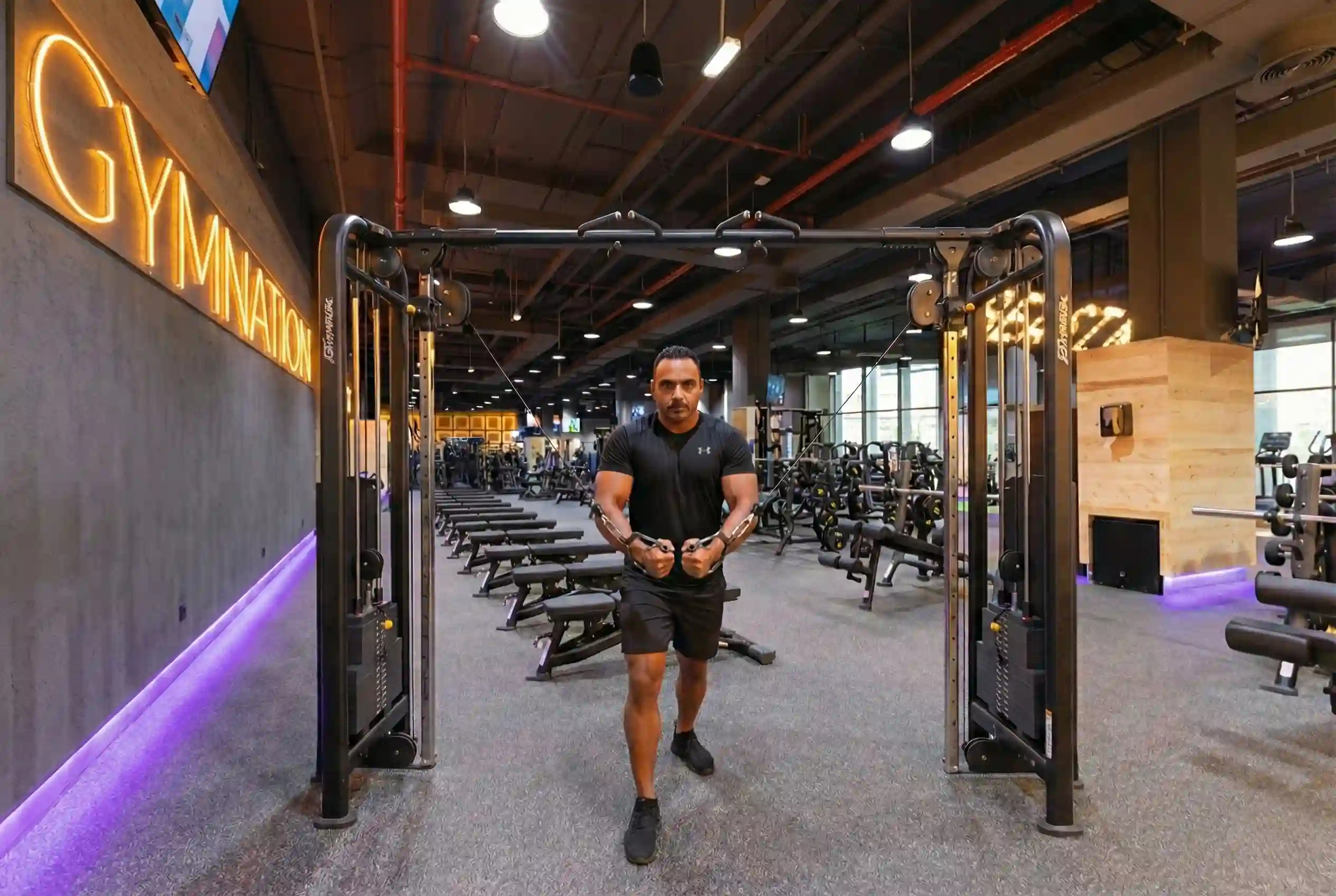
Set the cable pulleys to the desired height (high, middle, or low) on the cable crossover equipment. Attach cable handles and step forward into the starting position with feet shoulder width apart or slightly wider for stability.
-
Grip the cable handles with palms facing forward or inward. Pull the shoulder blades down and back, keep the core tight, chest lifted, and maintain a slight bend in the elbows throughout the movement.
-
Inhale and bring the arms together in a controlled arc, keeping the arms extended but not locked. Focus on squeezing the chest muscles as the handles meet at chest height.
-
At the point of peak contraction, pause briefly to maximise muscle activation and inner chest engagement.
-
Slowly release the handles back to the starting position, maintaining control, continuous tension, and a full range of motion.
Personal Trainer Notes:
-
Keep elbows slightly bent to protect the shoulder joint
-
Avoid using too much weight; control is key for muscle hypertrophy
-
Maintain shoulder blades retracted to reduce injury risk
-
Focus on continuous tension rather than momentum
-
Adjust cable height to target upper chest, mid-chest, or lower pecs
-
Single-arm cable crossover variations can help correct muscle imbalances
 WHATSAPP
 EMAIL
EMAIL
 SHARE VIA
Alternative Chest Exercises

Push-up
The Push-up is a bodyweight exercise that builds strength in the chest (pectorals), shoulders (deltoids), arms (triceps), and core (abdominals).

Cable Standing Fly
The cable standing fly is a highly effective chest exercise that isolates the chest muscles using constant tension from the cable machine.

Dumbbell Fly
The Dumbbell Fly targets the chest (pectorals) while also involving the shoulders (anterior deltoids) and arms (biceps). It’s designed to stretch and contract the chest muscles through a wide range, improving flexibility and muscle tone.

Dumbbell Incline Bench Press
The Dumbbell Incline Bench Press works the upper chest (clavicular pectorals), shoulders (anterior deltoids), and triceps. It helps improve upper chest definition and balance between sides while building pressing power.

Barbell Decline Bench Press
The Barbell Decline Bench Press targets the lower chest (lower pectorals) while also engaging the triceps and shoulders (anterior deltoids). The decline angle reduces shoulder strain and shifts more load to the lower pec fibres.

Smith Bench Press
The Smith Bench Press is a smith machine exercise that targets your pectorals. It also recruits the anterior deltoids and triceps to keep you stable and moving well from start to finish.

Cable Middle Fly
The Cable Middle Fly is a cable exercise that targets your pectorals. It also recruits the anterior deltoids and triceps to keep you stable and moving well from start to finish.

Chest Dip
The chest dip is one of the most effective upper-body body-weight exercises for building the chest muscles,
Cable Crossover Variation FAQs
Cable crossovers primarily target the chest muscles (pectoralis major), including the clavicular head (upper chest) and sternal head. The anterior deltoids assist, while the biceps brachii and core stabilise the movement.
Each angle targets the chest differently:
-
High-to-low cable crossover → lower chest
-
Low-to-high cable crossover → upper chest
-
Middle crossover → mid-chest
Rotating angles supports balanced chest development.
There is no single best variation. Using different angles, single-arm cable crossover variations, and controlled tempos allows you to target weak points and improve muscle activation.
Use a soft bend in the elbows, move the arms in a controlled arc, squeeze the chest at the top, and slowly release back under control. Common cable crossover mistakes include using too much weight, locking the elbows, losing shoulder blade control, and shortening the range of motion.
Yes. With progressive overload, proper volume, and full range of motion, cable exercises alone can build significant chest muscle and mass.
No. They are not mandatory, but they are highly effective for isolation, hypertrophy, and finishing work, especially when barbell bench press volume is limited.
Effective alternatives include dumbbell flyes, pec deck machines, resistance band flyes, ring flyes, and band crossovers. Bands provide the closest match to cable tension.
Resistance bands, power bands, gymnastic rings, or dumbbells can replicate the same chest adduction movement pattern.
Using excessive weight, locking the elbows, losing shoulder blade control, relying on momentum, and failing to use a full range of motion.
An advanced intensity technique involving overloaded eccentrics or partial reps. It is intended for advanced lifters only and should be used sparingly.