

Smith Bench Press
Smith Bench Press Video Guide
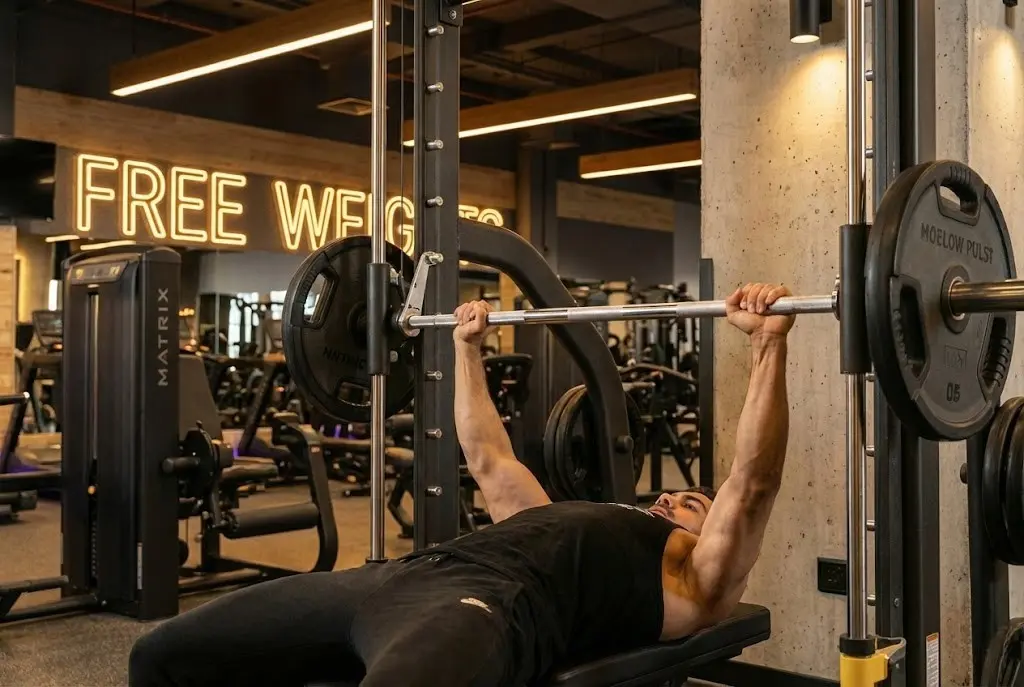
The Smith bench press is a chest exercise performed on a Smith machine using a fixed bar path. This gym equipment consists of a barbell that slides up and down two steel rails, providing a stable and controlled lifting environment. There are several types of Smith machines, including the standard vertical machine, which allows for straight up-and-down movements, and the angled version, which mimics the natural lifting motion of the body by altering the barbell's path. The Smith machine plays a valuable role in a workout routine, helping users achieve their fitness goals by offering a safe and effective way to perform pressing lifts. In comprehensive routines, the Smith machine press can be combined with dumbbells and other lifts, as dumbbells engage stabilizer muscles and promote functional strength. The Smith machine press allows for heavier loads due to its stability, but may not promote stabilizer muscle activation as effectively as the free weight bench press. To use the Smith machine effectively, ensure proper technique and setup for each exercise. Proper form and technique are essential for maximizing the benefits of the Smith machine bench press.
A key difference between the Smith machine bench press and the free weight bench press lies in the barbell's path and the engagement of stabilizer muscles. Free weights require the lifter to stabilize the bar across all planes of motion, engaging more stabilizer muscles and demanding correct form and technique, which builds superior functional strength and coordination. This also means that free weight training has a steeper learning curve and typically requires a spotter for safety, but it allows for a more natural range of motion and improved joint health. In contrast, the Smith machine bench press is generally considered easier due to its fixed plane of motion, which reduces the need for stabilizer muscle activation and allows for a controlled movement. The benefits of the Smith machine include enhanced safety, reduced injury risk for beginners, and the ability to focus on the primary muscles worked—mainly the pectoralis major, anterior deltoids, and triceps—making it an excellent option for those new to weightlifting or training without a spotter.
Compared to a barbell bench press, the Smith machine bench press places less emphasis on balance and coordination and more emphasis on muscle activation through a controlled range of motion. This makes it useful for hypertrophy-focused training, tempo work, and lifters who want to train the chest with heavier weights or higher volume while reducing injury risk. However, because the barbell’s path is fixed, correct setup is critical to avoid unnecessary stress on the shoulders, elbows, and wrists.
The Smith bench press is commonly used in comprehensive workout routines alongside free weight bench press variations such as the barbell bench, dumbbell bench press, and incline bench press. When used correctly, it can support building strength, chest development, and confidence under load—especially for beginners, solo lifters, or those training in gyms like Planet Fitness where free barbells may be limited.
How to Perform the Smith Bench Press:
-
Adjust the flat bench and the Smith machine bar to the right height so that when you lie down, the bar is aligned with your chest at mid-grip. Lie flat on the bench with your feet placed at hip width for stability, knees bent, and hips set. Position your eyes directly under the bar and grip it at about shoulder width, using a grip that feels natural for your shoulders and wrists.
-
Pull your shoulder blades down and back into the bench to create a stable pressing base. Keep your chest lifted, core engaged, and head resting on the bench throughout the movement.
-
Unrack the bar and inhale as you lower it in a straight line toward the mid-chest. Keep the elbows slightly tucked rather than flared, allowing the bar to make light contact with the chest or stop just above it depending on comfort.
-
Pause briefly at the bottom to maintain tension through the chest muscles and reinforce control. Avoid bouncing the bar or relaxing at the lowest point.
-
Exhale and push the bar upward along the fixed path until your arms are straight (but not locked out). Focus on the push motion, squeezing the chest and triceps while keeping the shoulders stable.
-
Control the descent on each rep and repeat for smooth, consistent repetitions using proper form rather than excessive load.
GymNation Tips:
-
Engage your core and maintain proper posture throughout the exercise for safety and effectiveness.
-
Common mistakes include bouncing the bar off the chest and using excessive weight.
-
Start with lighter weights and gradually increase as you become more comfortable with the movement.
-
Use proper breathing techniques: inhale while lowering the bar, exhale while pressing up.
-
Always warm up before and cool down after your Smith bench press session to help prevent injury.
Personal Trainer Notes:
-
Set the bench height so the bar meets your chest naturally
-
Keep feet flat and planted to maintain full-body tension
-
Avoid excessive flaring of the elbows
-
Use slower tempo to increase muscle activation
-
Stop sets early if shoulder discomfort appears
 WHATSAPP
 EMAIL
EMAIL
 SHARE VIA
Alternative Chest Exercises

Push-up
The Push-up is a bodyweight exercise that builds strength in the chest (pectorals), shoulders (deltoids), arms (triceps), and core (abdominals).

Incline Push-up
The Incline Push-Up is a bodyweight exercise that targets your pectorals. It also recruits the anterior deltoids and triceps to keep you stable and moving well from start to finish.

Dumbbell Pullover
The Dumbbell Pullover is a dumbbell exercise that targets your pectorals. It also recruits the anterior deltoids and triceps to keep you stable and moving well from start to finish.

Cable Middle Fly
The Cable Middle Fly is a cable exercise that targets your pectorals. It also recruits the anterior deltoids and triceps to keep you stable and moving well from start to finish.

Chest Dip
The chest dip is one of the most effective upper-body body-weight exercises for building the chest muscles,

Barbell Incline Bench Press
The Barbell Incline Bench Press targets the upper chest (clavicular pectorals) and front shoulders (anterior deltoids), with support from the triceps. It’s ideal for developing shape and definition across the upper chest.

Dumbbell Bench Press
The Dumbbell Bench Press builds strength through the chest (pectorals), shoulders (anterior deltoids), and triceps. Using dumbbells allows greater range of motion and helps correct imbalances between sides.

Cable Bench Press
The Cable Bench Press is a cable exercise that targets your pectorals. It also recruits the anterior deltoids and triceps to keep you stable and moving well from start to finish.
Smith Bench Press FAQs
Yes. The Smith bench press is a valid exercise for hypertrophy, controlled reps, and training close to failure. It’s not a perfect replacement for free weight benching, but it’s a useful tool.
The Smith machine bench press primarily works the chest (pectoralis major), with assistance from the triceps and anterior deltoids. Stabiliser muscle involvement is reduced compared to a barbell bench press.
No. A barbell bench press requires full stabilisation and allows a natural bar path, while the Smith machine uses a fixed path. Muscle activation and skill transfer differ.
No. Smith machine bars vary by manufacturer and usually weigh between 6–15 kg. Always check the machine’s label.
Only standard Olympic barbells weigh 20 kg. Smith machine bars and fixed bars often weigh less.
You can usually lift more because the fixed path reduces stabiliser demand and some machines counterbalance part of the load.
Often yes, but it depends on the machine. Some Smith machines reduce effective load, others do not.
Reduced stabiliser activation, less carryover to free weight bench press strength, and potential shoulder stress if setup is poor.
It can help build muscle and pressing strength, but maximal strength transfer is better developed with free weights.
Yes—especially for hypertrophy, safer solo training, controlled tempo work, and chest isolation after heavy barbell or dumbbell pressing.