

Incline Push-up
Incline Push-up Video Guide
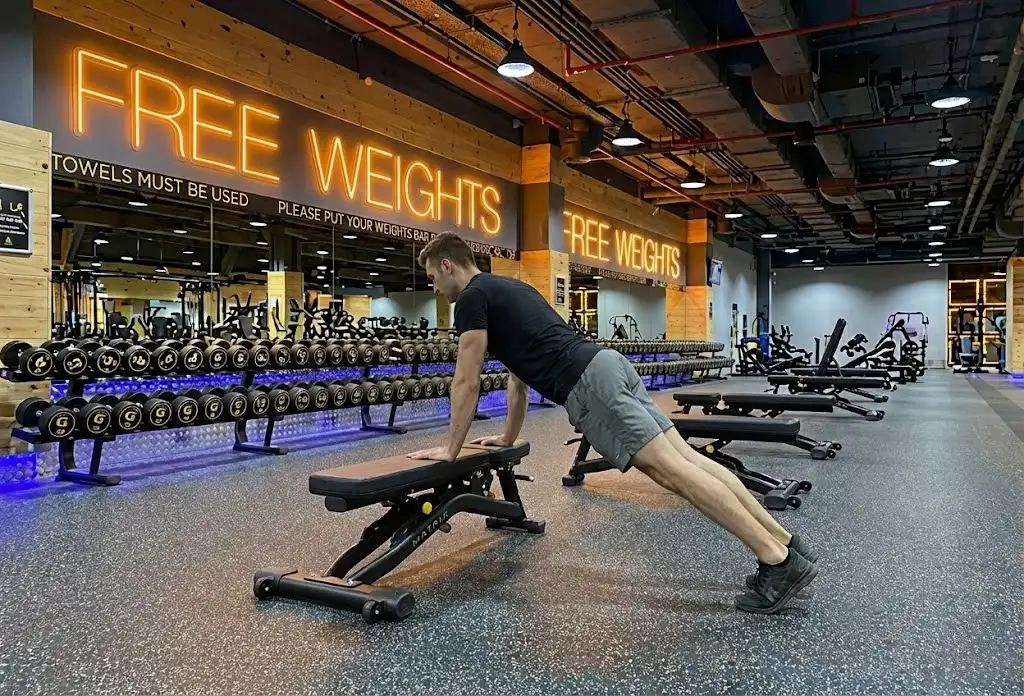
The incline push-up is a bodyweight chest exercise performed with the hands on an elevated surface such as a bench, box, or step. This incline angle reduces the percentage of body weight being lifted, making the movement more accessible while still training the chest muscles, shoulders, and triceps through a full range of motion. Compared to traditional push-ups, incline push-ups place less stress on the wrists and shoulder joints, making them ideal for beginners, rehabilitation, and high-volume training.
The primary muscle worked is the pectoralis major, with more emphasis on the lower chest muscles due to the torso angle. Secondary muscles include the triceps brachii, anterior deltoids, core muscles, and other stabiliser muscles that maintain a straight line from head to heels. Because the body remains in a plank position, incline push-ups also challenge the abdominal muscles, glutes, and lower body to maintain proper alignment.
Incline push-ups train the same muscle groups as standard push-ups but at a lower difficulty level. This makes them useful for building upper body strength, learning proper push-up mechanics, and accumulating volume without excessive fatigue. As strength improves, the incline height can be gradually reduced to increase resistance and progress toward standard or decline push-ups.
How to Perform the Incline Push-up:
-
Place your hands on an elevated surface such as a bench, box, or sturdy platform. Set your hands at shoulder width apart or slightly wider, depending on comfort. Extend your legs behind you so your body forms a straight line from head to heels, with toes on the floor.
-
Engage your core muscles and glutes to maintain straight alignment through the torso and hips. Keep your head neutral, eyes looking slightly ahead, and avoid letting the hips sag or rise.
-
Inhale and slowly lower your chest toward the elevated surface by bending your elbows. Keep the elbows angled slightly back rather than flaring straight out, and lower until your chest is close to the bench while maintaining control.
-
Pause briefly near the bottom position to maintain tension through the chest muscles and reinforce good form.
-
Exhale and push through your palms to extend the arms, pressing your body back to the starting position. Focus on squeezing the chest and triceps while keeping the body straight.
-
Control the movement through the entire range and repeat for smooth, even repetitions. Maintain proper form throughout the set rather than rushing the reps.
Personal Trainer Notes:
-
Keep the body straight from head to heels at all times
-
Hands should be shoulder width apart or slightly wider
-
Lower the chest under control—don’t drop or bounce
-
Gradually reduce the incline height as strength improves
-
Stop the set if form breaks or the hips lose alignment
 WHATSAPP
 EMAIL
EMAIL
 SHARE VIA
Alternative Chest Exercises

Cable Lying Fly
The Cable Lying Fly is a cable exercise that targets your pectorals. It also recruits the anterior deltoids and triceps to keep you stable and moving well from start to finish.

Dumbbell Decline Bench Press
The Dumbbell Decline Bench Press focuses on the lower chest (pectorals) while engaging the triceps and shoulders (anterior deltoids). It helps shape and strengthen the lower pecs and improves pressing balance between sides. Keep your movements steady to maintain control.

Barbell Decline Bench Press
The Barbell Decline Bench Press targets the lower chest (lower pectorals) while also engaging the triceps and shoulders (anterior deltoids). The decline angle reduces shoulder strain and shifts more load to the lower pec fibres.

Barbell Incline Bench Press
The Barbell Incline Bench Press targets the upper chest (clavicular pectorals) and front shoulders (anterior deltoids), with support from the triceps. It’s ideal for developing shape and definition across the upper chest.

Dumbbell Incline Bench Press
The Dumbbell Incline Bench Press works the upper chest (clavicular pectorals), shoulders (anterior deltoids), and triceps. It helps improve upper chest definition and balance between sides while building pressing power.

Dumbbell Decline Fly
The Dumbbell Decline Fly is a dumbbell exercise that targets your pectorals. It also recruits the anterior deltoids and triceps to keep you stable and moving well from start to finish.

Cable Standing Fly
The cable standing fly is a highly effective chest exercise that isolates the chest muscles using constant tension from the cable machine.

Dumbbell Bench Press
The Dumbbell Bench Press builds strength through the chest (pectorals), shoulders (anterior deltoids), and triceps. Using dumbbells allows greater range of motion and helps correct imbalances between sides.
Incline Push-up FAQs
Incline push-ups are excellent for beginners, rehabilitation, and high-rep training. They build upper body strength while reducing stress on the shoulders and wrists compared to standard push-ups.
Yes. Incline push-ups place more emphasis on the lower chest muscles because the torso angle shifts resistance downward.
No. Upper chest development is better targeted with decline push-ups, incline presses, or low-to-high flyes.
Yes. The elevated surface reduces the amount of body weight lifted, making incline push-ups easier than traditional push-ups.
Neither is better overall. Incline push-ups are ideal for learning proper form and building capacity, while standard push-ups provide a greater strength stimulus once you’re ready.
Yes, especially for beginners. However, muscle growth will plateau unless difficulty is increased by lowering the incline, adding reps, slowing tempo, or progressing to harder variations.
For strength and muscle development, aim for 3–5 sets of 8–20 reps with good form. Higher reps can be used for endurance and conditioning.
Common mistakes include letting the hips sag, flaring the elbows excessively, rushing reps, or reducing range of motion.
Incline push-ups emphasise the lower chest and are easier, while decline push-ups place more load on the upper chest and shoulders and are more challenging.
They are a progression tool, not a permanent replacement. Gradually lowering the surface height helps transition toward standard push-ups as strength improves.