

Cable Lying Fly
Cable Lying Fly Video Guide
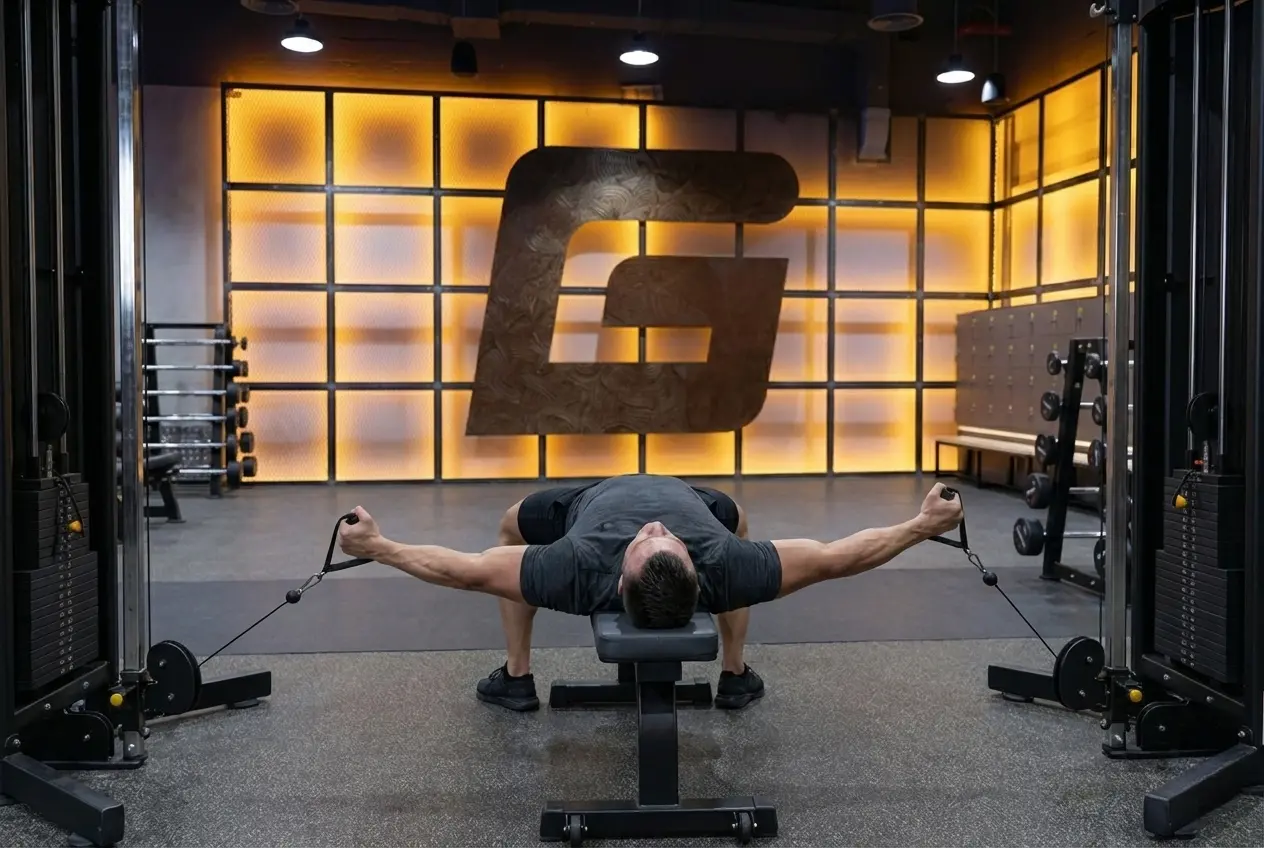
The cable lying fly is a chest isolation exercise performed lying flat on a bench using a cable machine. It primarily targets the chest muscles (pectoralis major) by emphasising horizontal arm adduction while maintaining constant tension through the entire range of motion. Unlike pressing movements, the cable lying fly minimises elbow extension and focuses on controlled stretching and contraction of the chest.
Compared to the dumbbell fly, which uses dumbbells and free weights, the cable lying fly offers a different mechanical challenge. Dumbbell flyes rely on gravity and can place more strain on the shoulder joint, especially at the bottom of the movement. In contrast, cables provide constant resistance, allowing you to better engage the pectorals throughout the entire range of motion. This makes the cable lying fly a safer option for beginners and those looking to maximize muscle activation. While dumbbells are versatile and effective for chest development, cable machines allow for more precise adjustments and muscle targeting. Other chest exercises, such as the bench press, require a bar or barbell, which can be preferable for building overall strength but may not isolate the chest as effectively as fly variations.
Lying flat on a bench increases stability compared to standing cable fly variations, making it easier to maintain proper form, control the movement, and keep tension on the chest muscles. This stable position limits lower-body involvement and reduces momentum, which helps fitness enthusiasts isolate the chest more effectively. Additionally, this exercise stabilizes the shoulders and reduces strain compared to free weights, making it safer for beginners and those concerned about joint health.
Because cables provide resistance throughout the movement, the cable chest fly maintains tension at both the stretched and contracted positions—something free weights cannot fully replicate. Cable machines also allow for a greater range of motion compared to free weights, which may help in building more muscle size. Secondary muscles include the anterior deltoids, biceps, triceps (as stabilisers), and core, which assist with shoulder control and body positioning. When performed with a slight bend in the elbows and proper shoulder blade retraction, the cable lying fly places less stress on the shoulder joint than heavy dumbbell flyes.
Proper performance of cable lying flies requires a flat bench and a cable crossover machine. By adjusting the height of the cables, you can emphasize different areas of the chest: setting the cables lower targets the upper chest (clavicular head), while a neutral position focuses on the middle chest, and higher cables can shift emphasis to the lower chest. This versatility allows you to engage and maximize activation of the pectorals for balanced muscle development and improved definition.
This exercise is commonly used as an accessory or finishing movement in chest training and pairs well with pressing exercises such as the bench press or cable chest press. It is especially effective for improving chest activation, symmetry, and muscle detail. Focusing on slow, controlled movements helps maximize results and supports overall health. Working with a professional trainer or following a tailored program can further enhance health outcomes and ensure proper technique for the best results.
How to Perform the Cable Lying Fly:
-
Place a flat bench between two low cable pulleys and attach handles to each side. Lie flat on the bench with your feet planted firmly on the floor, legs stable, and body aligned. While the cable lying fly uses both feet for stability, standing cable fly variations may use a staggered stance for balance. For all variations, correct cable placement at shoulder height is crucial for effective chest engagement.
-
Grab the handles with palms facing each other or using a neutral grip, maintaining a firm and controlled hold. Extend the arms forward at shoulder height with a soft bend in the elbows. The arms should remain extended but not locked, with the handles aligned with the chest and just above shoulder level.
-
Pull the shoulder blades down and back to stabilise the shoulders and improve chest activation. Keep the chest lifted and the head supported on the bench. This position helps protect the shoulder joint and keeps tension focused on the chest muscles.
-
Inhale and slowly lower the arms outward in a wide arc over 2–3 seconds, allowing the handles to move toward the cable machine. Maintain tension through the chest, keep the elbows slightly bent, and hold the arms parallel to the floor. Avoid excessive weight to prevent arching the back or using momentum. Slow, controlled movement maximises muscle activation and safety.
-
Exhale and bring the handles back toward the start position in a controlled arc, pushing through the chest rather than the arms. Focus on squeezing the chest at the strongest point of the movement. Lead slightly with the pinkies and stop just before the handles touch, avoiding turning the movement into a cable crossover.
-
Control the return into the stretched position and repeat for smooth, even repetitions, maintaining tension through the entire range of motion.
Personal Trainer Notes:
-
Maintain a slight bend in the elbows throughout
-
Keep shoulder blades pinned for joint safety
-
Avoid turning the fly into a press
-
Use moderate weight to maximise tension and control
-
Focus on slow eccentrics to increase chest activation
The cable lying fly is a joint-friendly option that helps reduce shoulder strain compared to free weights and can assist in correcting left–right strength imbalances in the chest.
 WHATSAPP
 EMAIL
EMAIL
 SHARE VIA
Alternative Chest Exercises

Dumbbell Bench Press
The Dumbbell Bench Press builds strength through the chest (pectorals), shoulders (anterior deltoids), and triceps. Using dumbbells allows greater range of motion and helps correct imbalances between sides.

Push-up
The Push-up is a bodyweight exercise that builds strength in the chest (pectorals), shoulders (deltoids), arms (triceps), and core (abdominals).

Chest Dip
The chest dip is one of the most effective upper-body body-weight exercises for building the chest muscles,

Dumbbell Incline Fly
The Dumbbell Incline Fly isolates the upper chest (clavicular pectorals) with support from the shoulders (anterior deltoids). It enhances muscle definition and helps develop upper chest control.

Dumbbell Incline Bench Press
The Dumbbell Incline Bench Press works the upper chest (clavicular pectorals), shoulders (anterior deltoids), and triceps. It helps improve upper chest definition and balance between sides while building pressing power.

Cable Bench Press
The Cable Bench Press is a cable exercise that targets your pectorals. It also recruits the anterior deltoids and triceps to keep you stable and moving well from start to finish.

Dumbbell Fly
The Dumbbell Fly targets the chest (pectorals) while also involving the shoulders (anterior deltoids) and arms (biceps). It’s designed to stretch and contract the chest muscles through a wide range, improving flexibility and muscle tone.

Dumbbell Decline Bench Press
The Dumbbell Decline Bench Press focuses on the lower chest (pectorals) while engaging the triceps and shoulders (anterior deltoids). It helps shape and strengthen the lower pecs and improves pressing balance between sides. Keep your movements steady to maintain control.
Cable Lying Fly FAQs
Cable lying flyes primarily target the chest muscles (pectoralis major). Secondary muscles include the front deltoids, biceps, triceps (stabilisers), and core.
Cable flyes mainly work the chest, with the shoulders, arms, and core assisting for stability. Cable height and bench angle determine which chest portion is emphasised.
Yes. Lying flat increases stability, reduces momentum, and helps maintain constant tension compared to standing variations.
Yes. Cable flyes are excellent for hypertrophy due to constant tension, controlled resistance, and joint-friendly loading.
Flyes build muscle, but maximum size and strength are best achieved when combined with pressing exercises.
Neither is better overall. Presses build strength and mass; flyes improve isolation, stretch, and muscle detail. Both should be included.
-
Low-to-high → upper chest
-
Mid-level / lying → mid chest
-
High-to-low → lower chest
Cable lying flyes are performed on a bench with a fixed arc and greater stability. Cable crossovers are usually standing and allow a larger range of motion and stronger peak contraction.
No—when performed with proper control, reasonable weight, and good shoulder positioning.