
Push-up
Push-Up Video Guide
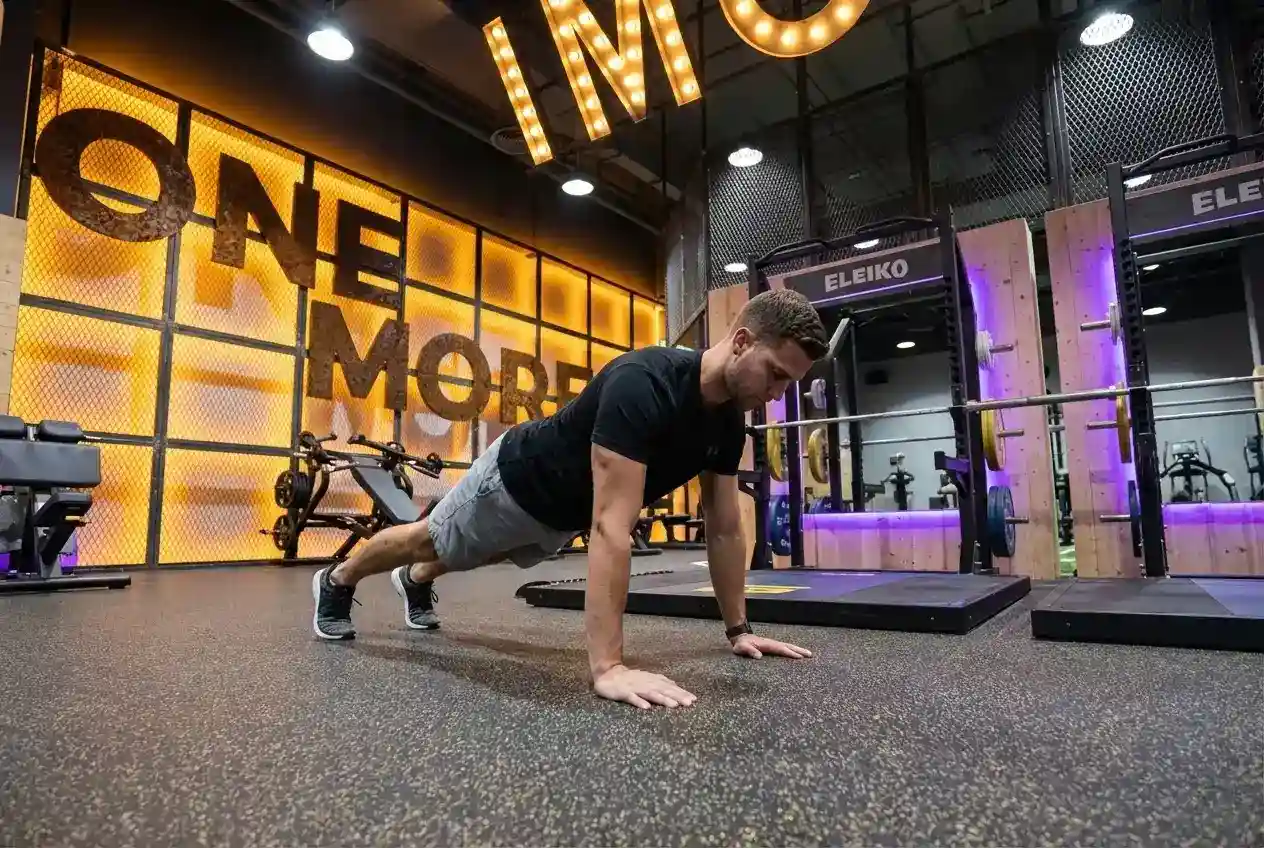
The push-up is a classic body-weight chest exercise that builds upper body strength by training the pectoralis major muscles, chest muscles, upper arms, shoulders, triceps, and core muscles. A proper starting position in a high plank position, with feet hip-width apart and the body held in a straight line from head to heels, helps activate multiple muscle groups while improving shoulder stability, core control, and overall upper-body performance.
Unlike machine pressing or the bench press, the push-up exercise uses your entire body weight and reinforces joint-friendly movement patterns supported by exercise science and strength and conditioning research. Variations such as incline push-ups, decline push ups, diamond push-ups, knee push-ups, plyometric push-ups, wall push-ups, and one-arm push-up options allow the push-up variation to scale from a basic exercise to an advanced exercise.
The number of push-ups performed is commonly used to track progress, and the push-up test is a widely recognised method for assessing upper body strength, endurance, and general fitness levels.
How to Perform a Standard Push-Up (Proper Form)
To perform a normal push-up (also known as a regular push-up or standard press-ups), follow these steps:
-
Start in a push-up position with hands slightly wider than shoulder width and fingers pointing forward (index fingers ahead). Position your feet hip-width apart for stability.
-
Hold a tight core and maintain a strong plank position, drawing the belly button in to support spinal alignment.
-
Lower your chest in the downward phase by slowly bending the elbow joints to roughly 90°.
-
Push through the floor and press back up into the fully extended upward phase, keeping the body in a straight line.
-
Maintain control and perform push ups for the desired number of reps using controlled reps rather than momentum.
GymNation Tip: If your wrists feel uncomfortable, use push up bars or adjust hand placement. If you experience shoulder pain, avoid excessive elbow flare and maintain proper form throughout the movement.
Personal Trainer Notes:
-
Keep a slight bend in the elbows at the top — do not fully lock out.
-
Engage a strong, tight core throughout to prevent sagging or piking.
-
Controlled reps produce better muscle activation than rushing.
-
If regular push-ups are too difficult, use incline push-ups, wall push-ups, or knee push-ups to build strength.
-
For a more challenging variation, try feet-raised push-ups, diamond push-ups, or plyometric push-ups.
-
Track how many push ups you perform to monitor progress.
-
Proper elbow and arm positioning reduces stress on the shoulder joints and helps prevent shoulder pain.
 WHATSAPP
 EMAIL
EMAIL
 SHARE VIA
Alternative Chest Exercises

Dumbbell Incline Fly
The Dumbbell Incline Fly isolates the upper chest (clavicular pectorals) with support from the shoulders (anterior deltoids). It enhances muscle definition and helps develop upper chest control.

Dumbbell Decline Bench Press
The Dumbbell Decline Bench Press focuses on the lower chest (pectorals) while engaging the triceps and shoulders (anterior deltoids). It helps shape and strengthen the lower pecs and improves pressing balance between sides. Keep your movements steady to maintain control.

Barbell Incline Bench Press
The Barbell Incline Bench Press targets the upper chest (clavicular pectorals) and front shoulders (anterior deltoids), with support from the triceps. It’s ideal for developing shape and definition across the upper chest.

Smith Decline Bench Press
The Smith Decline Bench Press is a smith machine exercise that targets your pectorals. It also recruits the anterior deltoids and triceps to keep you stable and moving well from start to finish.

Smith Bench Press
The Smith Bench Press is a smith machine exercise that targets your pectorals. It also recruits the anterior deltoids and triceps to keep you stable and moving well from start to finish.

Incline Push-up
The Incline Push-Up is a bodyweight exercise that targets your pectorals. It also recruits the anterior deltoids and triceps to keep you stable and moving well from start to finish.

Dumbbell Pullover
The Dumbbell Pullover is a dumbbell exercise that targets your pectorals. It also recruits the anterior deltoids and triceps to keep you stable and moving well from start to finish.

Cable Middle Fly
The Cable Middle Fly is a cable exercise that targets your pectorals. It also recruits the anterior deltoids and triceps to keep you stable and moving well from start to finish.

Cable Incline Bench Press
The Cable Incline Bench Press is a cable exercise that targets your pectorals. It also recruits the anterior deltoids and triceps to keep you stable and moving well from start to finish.
Push-up FAQs
Push-ups work the chest muscles, pectoralis major (pectoral muscles), upper arm muscles, anterior deltoids, triceps, abdominal muscles, and forearm muscles. They train multiple muscle groups and strengthen the core while improving shoulder stability.
Yes. Push-ups are a compound exercise that engages the chest, shoulders, arms, and core simultaneously. They’re also commonly referred to as press-ups or standard press-ups.
-
Beginners: 8–12 controlled reps
-
Intermediate: 15–25 push ups
-
Advanced: 30+ traditional push ups or a challenging variation
The number of push-ups performed is a useful way to track upper body strength and endurance.
Yes. Incline push-ups reduce body-weight load and are ideal for learning proper form. Decline push-ups increase difficulty by placing more load on the upper body.
Yes. With full range of motion, a straight-line body position, and appropriate variation, push-ups build muscle, improve strength, and enhance athletic performance according to exercise science.
Shoulder pain usually comes from poor alignment, insufficient warm-up, or excessive elbow flare. Maintain a strong core, keep elbows in a safer position, and ensure proper form to reduce strain.
There is none — they are the same movement. “Press-ups” is the UK term, while “push-ups” is more common internationally.
A push-up variation is any modification of the standard push-up. Incline, decline, diamond, wall, explosive, and one-arm push-ups adjust difficulty and muscle emphasis.
The push-up test measures the maximum number of push-ups performed with correct form and is commonly used in fitness assessments.
Yes. Plyometric push ups improve explosive power and are commonly used in athletic training. Some advanced variations transition explosively between standing position and the floor.