

Dumbbell Decline Bench Press
Dumbbell Decline Bench Press Video Guide
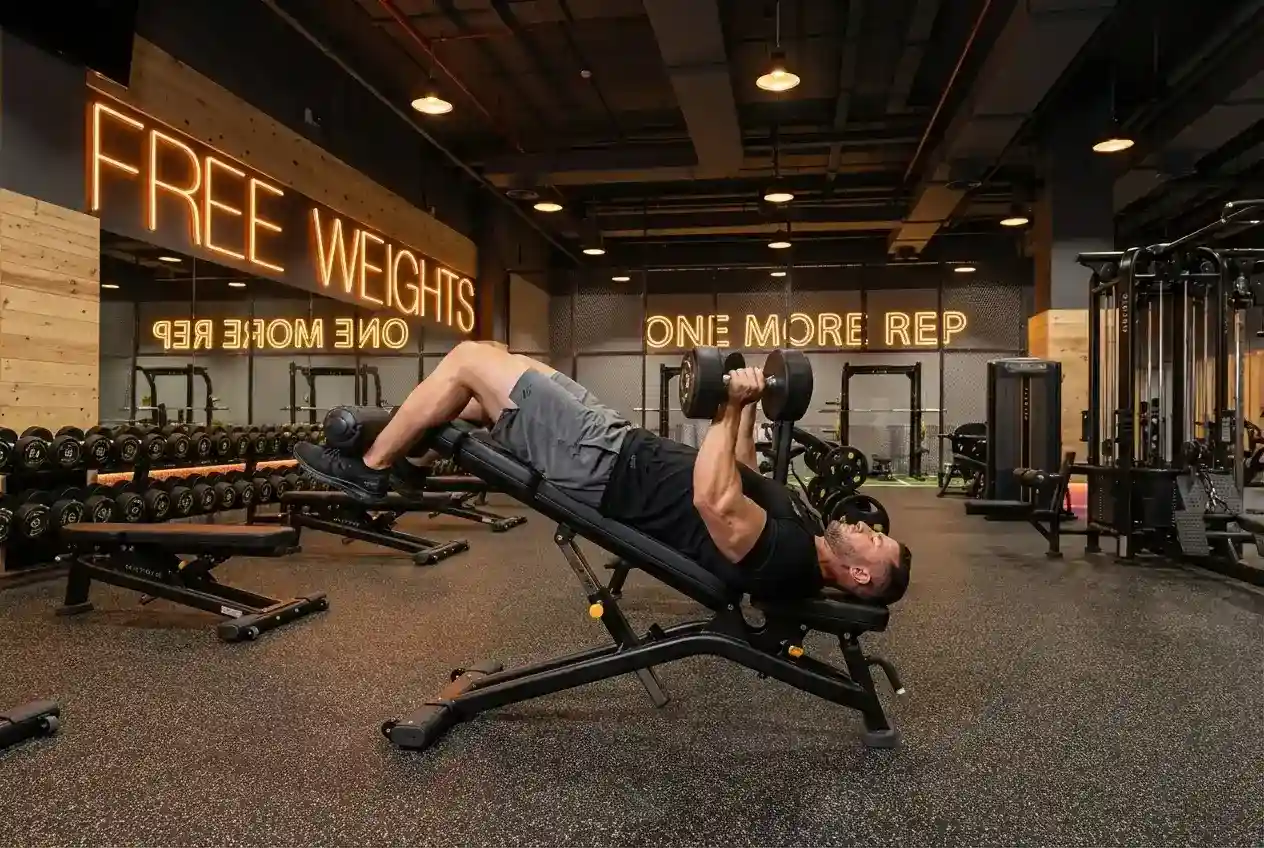
The decline dumbbell bench press is a bench press variation designed to emphasise the lower fibres of the pectoralis major (the inferior portion of the sternal head), while still engaging the triceps brachii and anterior deltoid. The decline angle shifts the pressing line of force downward, increasing mechanical tension on the lower chest fibres and slightly reducing anterior deltoid involvement compared with flat and incline pressing.
Using dumbbells instead of a decline barbell bench press increases the range of motion, improves unilateral strength, and helps correct side-to-side imbalances. With a strong starting position, shoulder blades retracted, palms facing forward, and feet locked into the bench supports, the movement becomes one of the most effective bench press exercises for developing the lower portion of the chest. It’s a staple for athletes seeking balanced upper body development and high-quality muscle activation from top to bottom of the pecs.
How to Perform the Dumbbell Decline Bench Press
-
Set your decline bench to the ideal position and hold a dumbbell in each hand, pressing them to arm’s length above the lower chest in the starting position.
-
Slowly lower the dumbbells toward the lower pecs, keeping elbows tucked slightly and wrists neutral.
-
Press the dumbbells back up in a smooth arc, extending the arms without locking out hard.
-
Maintain full control—no bouncing, no swinging—keeping tension on the chest muscles throughout the movement.
-
Repeat for smooth, controlled reps, keeping your shoulder blades tight and your torso stable.
GymNation Tip: A controlled descent increases activation. Don’t rush the bottom—this is where the decline version shines.
Personal Trainer Notes:
-
Keep elbows slightly tucked to maximise lower chest recruitment.
-
Maintain retracted shoulder blades for a stable press.
-
Use moderate loads first—decline angles exaggerate leverage.
-
Avoid over-arching; keep contact with the bench throughout.
-
A spotter is advised if pressing heavy weights.
 WHATSAPP
 EMAIL
EMAIL
 SHARE VIA
Alternative Chest Exercises

Dumbbell Incline Fly
The Dumbbell Incline Fly isolates the upper chest (clavicular pectorals) with support from the shoulders (anterior deltoids). It enhances muscle definition and helps develop upper chest control.

Dumbbell Incline Bench Press
The Dumbbell Incline Bench Press works the upper chest (clavicular pectorals), shoulders (anterior deltoids), and triceps. It helps improve upper chest definition and balance between sides while building pressing power.

Dumbbell Fly
The Dumbbell Fly targets the chest (pectorals) while also involving the shoulders (anterior deltoids) and arms (biceps). It’s designed to stretch and contract the chest muscles through a wide range, improving flexibility and muscle tone.

Barbell Incline Bench Press
The Barbell Incline Bench Press targets the upper chest (clavicular pectorals) and front shoulders (anterior deltoids), with support from the triceps. It’s ideal for developing shape and definition across the upper chest.

Incline Push-up
The Incline Push-Up is a bodyweight exercise that targets your pectorals. It also recruits the anterior deltoids and triceps to keep you stable and moving well from start to finish.

Cable Incline Fly
The Cable Incline Fly is a cable exercise that targets your pectorals. It also recruits the anterior deltoids and triceps to keep you stable and moving well from start to finish.

Cable Bench Press
The Cable Bench Press is a cable exercise that targets your pectorals. It also recruits the anterior deltoids and triceps to keep you stable and moving well from start to finish.

Cable Lying Fly
The Cable Lying Fly is a cable exercise that targets your pectorals. It also recruits the anterior deltoids and triceps to keep you stable and moving well from start to finish.
Dumbbell Decline Bench Press FAQs
It primarily trains the lower fibres of the pectoralis major (the inferior portion of the sternal head), with secondary involvement from the triceps brachii and anterior deltoid. The decline angle shifts the pressing line of force downward, increasing mechanical tension on the lower chest fibres compared with flat or incline pressing.
Mainly because the setup can feel awkward and decline benches are limited in some gyms. Despite this, it’s one of the most effective bench press variations for building balanced chest development.
Yes. It increases muscle activity in the lower pecs, complements flat bench and incline press work, and improves pressing power.
-
Beginner: 12–16 kg per hand
-
Intermediate: 22–26 kg
-
Advanced: 30 kg+ with clean form
Dumbbells offer greater range of motion, making it a compound exercise with improved unilateral control, and reduced shoulder stress. Barbells allow more weight. Advanced athletes often use both.
Yes — if you want complete chest development, especially the lower portion, rotating decline press into your routine is valuable for more emphasis on the lower chest .
-
Hypertrophy: 3–4 sets of 8–12 reps
-
Strength: 4–5 sets of 5–8 reps
Absolutely — start light, learn the proper form, and progress gradually.