

Cable Chest Fly Standing
Cable Chest Fly Overview
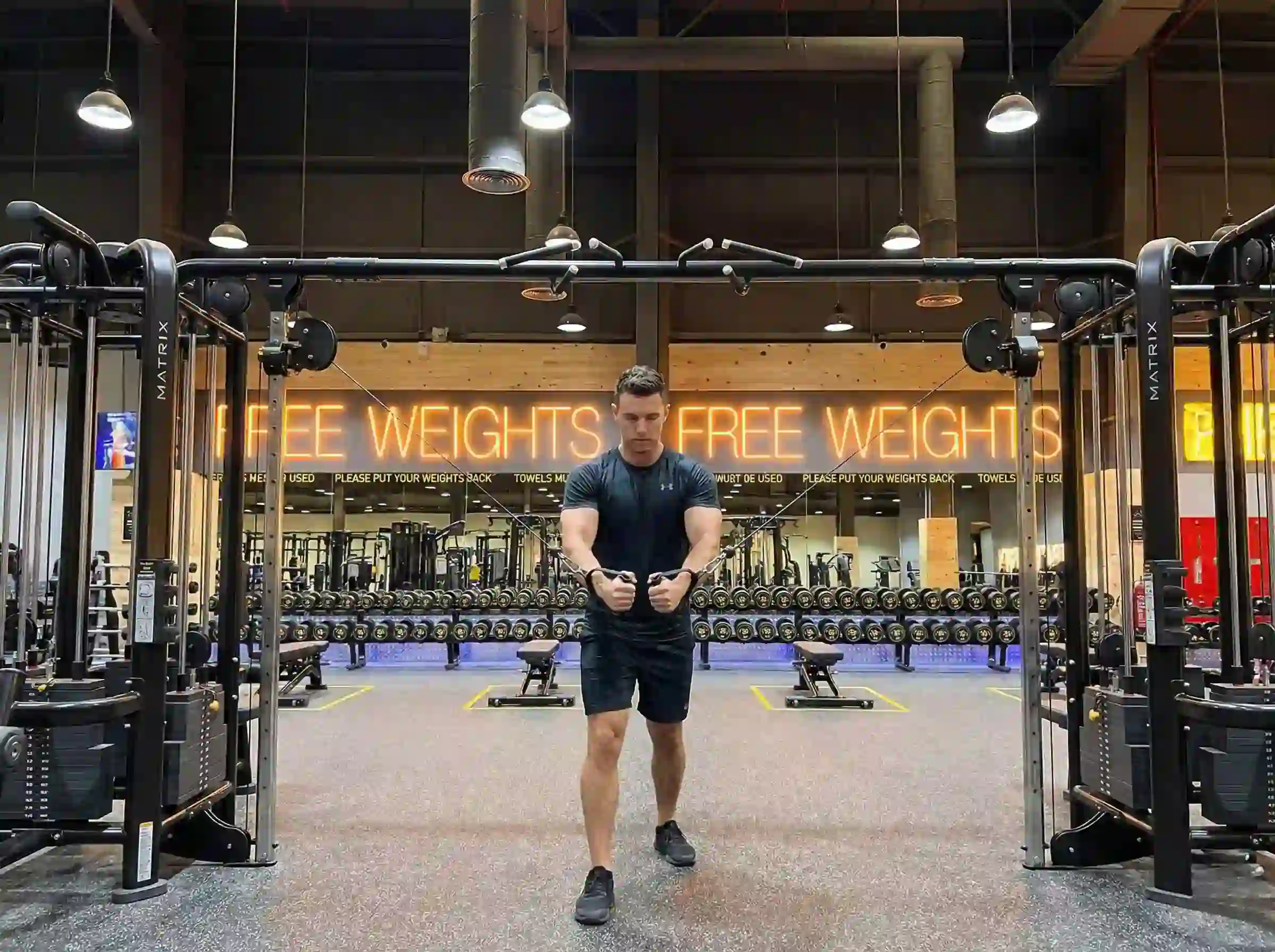
The standing cable chest fly is an effective upper-body cable exercise for building the chest muscles, with emphasis on the clavicular head and sternal head of the pectoralis major. Using cable attachments provides smoother resistance than dumbbells and maintains constant tension through the full range of motion. Performing the movement standing improves shoulder stability and posture while keeping tension on the chest with a controlled hugging motion and slightly bent elbows.
Unlike dumbbell flyes, cable flyes allow more control, constant tension at the top, and adjustable angles for upper-, mid-, and lower-chest emphasis. The standing position also engages core muscles to maintain balance, allowing you to focus on pulling the arms forward and squeezing the pecs. Using two cables, cable handles, and a staggered stance keeps tension on the pecs while reducing stress on the shoulder joint.
The main muscles worked are the pectoralis major, pectoralis minor, and anterior deltoids, with smaller involvement from biceps, core, and upper back muscles. Proper form — arms forward, slight bend in elbows, palms facing inwards, and controlled motion — prevents shoulder pain and improves muscle activation. When performed correctly, standing cable flyes support pressing strength in movements like bench press and push-ups while building chest shape and definition.
How to Perform Standing Cable Flyes (Proper Form)
-
Starting position: Set both pulleys slightly above shoulder height on the cable machine. Grip the cable handles with palms facing inward, elbows bent, and arms extended out to the sides. Step forward into a staggered stance, hips stable, core engaged, and chest lifted.
-
Arms forward: Bring your arms towards the midline of your body in a hugging motion, finishing with hands just short of touching. Keep elbows soft and shoulder blades controlled — never locked straight.
-
Slowly lower: Return to the start position under control and feel the stretch. Maintain constant tension; avoid letting the stacks rest.
-
Repeat: Use smooth resistance and focus on cable control, squeezing the pecs at the end of each rep.
GymNation Tip: Raise the cable attachments slightly higher for more clavicular-head focus, or keep them shoulder-height for mid-chest targeting.
Personal Trainer Notes (Form, Posture, Shoulder Safety)
-
Keep a slight bend in elbows — fully straight arms add stress to the shoulder joint.
-
Maintain palms facing inwards on the cable handles to keep tension on the pecs.
-
Use a staggered stance (one leg slightly forward) for body balance and stability.
-
Retract shoulder blades gently and avoid rounding forward — this protects posture.
-
Don’t turn the movement into a press. Maintain a fly arc with arms sweeping inward.
-
Avoid excessive weight. Good form, tension, and control build better results than loading up the stack.
-
Keep reps smooth — no jerking or swinging through the motion.
-
If you feel shoulder pain, reduce load, check elbow alignment, and avoid overstretching.
-
Use lighter weight and slower reps to increase muscle engagement and minimise strain.
-
Ensure cable height and handle positioning match your chest target (upper vs mid-chest).
 WHATSAPP
 EMAIL
EMAIL
 SHARE VIA
Alternative Chest Exercises

Dumbbell Fly
The Dumbbell Fly targets the chest (pectorals) while also involving the shoulders (anterior deltoids) and arms (biceps). It’s designed to stretch and contract the chest muscles through a wide range, improving flexibility and muscle tone.

Barbell Bench Press
The Barbell Bench Press strengthens the chest (pectorals), shoulders (anterior deltoids) and arms (triceps). It’s one of the most effective upper-body lifts for building power and muscle size.

Smith Bench Press
The Smith Bench Press is a smith machine exercise that targets your pectorals. It also recruits the anterior deltoids and triceps to keep you stable and moving well from start to finish.

Dumbbell Pullover
The Dumbbell Pullover is a dumbbell exercise that targets your pectorals. It also recruits the anterior deltoids and triceps to keep you stable and moving well from start to finish.

Cable Crossover Variation
The Cable Crossover Variation is a cable exercise that targets your pectorals. It also recruits the anterior deltoids and triceps to keep you stable and moving well from start to finish.

Push-up
The Push-up is a bodyweight exercise that builds strength in the chest (pectorals), shoulders (deltoids), arms (triceps), and core (abdominals).

Dumbbell Bench Press
The Dumbbell Bench Press builds strength through the chest (pectorals), shoulders (anterior deltoids), and triceps. Using dumbbells allows greater range of motion and helps correct imbalances between sides.

Cable Bench Press
The Cable Bench Press is a cable exercise that targets your pectorals. It also recruits the anterior deltoids and triceps to keep you stable and moving well from start to finish.
Cable Standing Fly FAQs
Yes. Cable standing flyes provide constant resistance on the chest and allow a greater range of motion than dumbbell fly variations. They’re ideal for developing the upper and mid-chest.
Primarily the pectoralis major (clavicular and sternal heads), with secondary involvement from the anterior deltoid and stabilising support from the serratus anterior, rotator cuff, and scapular stabilisers (middle and lower trapezius, rhomboids).
For many lifters, yes. Cable flyes maintain constant tension through the full movement, helping keep the pecs loaded from start to finish.
Keep a slight bend and maintain the same arc throughout. Locking the arms straight shifts tension into the joints.
Just above shoulder height for upper-chest focus, or shoulder-level for mid-chest. Always check your form: elbows soft, arms forward, posture controlled.
Yes — start light, maintain control, and increase load gradually.