

Decline Push-Up
Decline Push-Up Video Guide
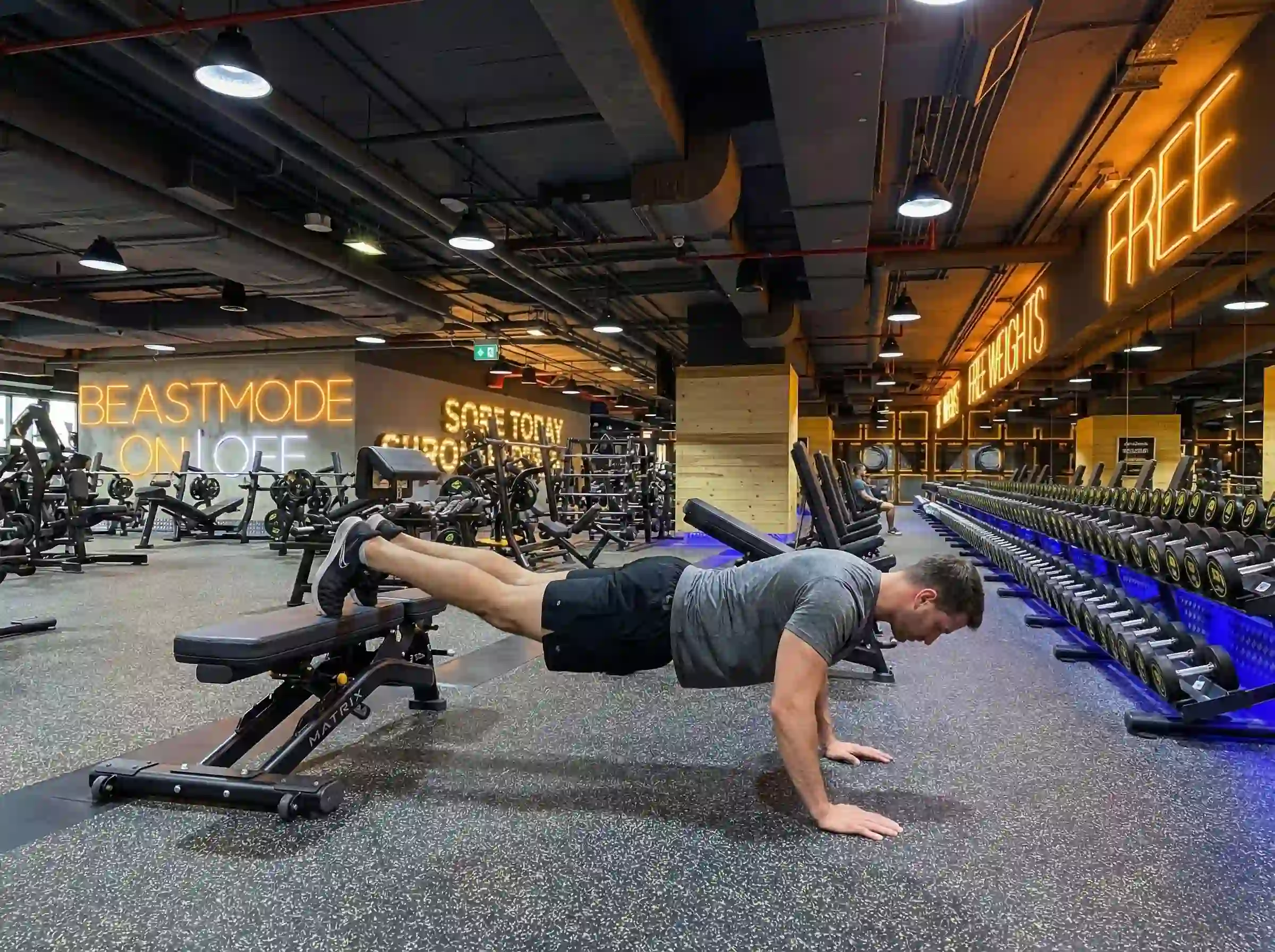
The decline push-up is a bodyweight push-up exercise that builds upper body strength, with primary emphasis on the upper chest (clavicular head of the pectoralis major), anterior deltoids, and triceps brachii. Elevating the feet on a bench, box, or other raised surface shifts more bodyweight toward the upper body, increasing resistance and making the exercise harder than regular pushups.
Compared to standard or incline push-ups, decline push-ups place greater demand on the upper pectoral muscles, shoulders, and core muscles, while requiring the body to remain in a straight line throughout the movement. This position increases activation of stabiliser muscles, including the serratus anterior, rectus abdominis, and deep shoulder stabilisers that help protect the rotator cuff when proper form is maintained.
Because no external load is required, decline press-ups are especially useful for home training, minimal-equipment workouts, or progressing bodyweight strength before adding tools such as a weighted vest, weighted belt, push up bars, or stability ball pushups. When performed through a full range of motion and with controlled tempo, decline push-ups are highly effective for building a bigger chest and improving pressing strength.
How to Perform the Decline Push-Up:
-
Set the starting position by placing your feet on an elevated surface such as a bench, box, or stability ball. The feet should be higher than the hands. Place your hands on the floor at shoulder width and assume a strong plank position.
-
Align your body in a straight line from head to heels. Brace the core muscles, squeeze the glutes, and keep the chest, hips, and legs moving as one unit. Avoid sagging or piking the hips.
-
Pull the shoulder blades slightly down and back to stabilise the shoulders. Keep the neck neutral and eyes looking slightly ahead of the hands rather than dropping the head.
-
Inhale and slowly lower your chest toward the floor by bending the elbows at roughly 30–45 degrees from the body. Lower until the chest is just above the ground or until shoulder mobility limits further depth.
-
Press through the palms and drive the body upward in the upward phase, extending the elbows while maintaining body tension and a straight line. Focus on squeezing the upper chest and triceps at the top.
-
Finish with the elbows extended but not locked out, then repeat for controlled repetitions through the full range of motion.
Personal Trainer Notes:
-
Maintain proper form before increasing foot height or resistance
-
Keep elbows from flaring excessively to reduce shoulder pain risk
-
Use slow eccentrics to increase muscle tension and control
-
If shoulder discomfort occurs, reduce the height of the feet
-
Decline push-ups can be progressed with a weighted vest or weighted belt
-
For beginners, regress to regular pushups or incline pushups
 WHATSAPP
 EMAIL
EMAIL
 SHARE VIA
Alternative Chest Exercises

Chest Dip
The chest dip is one of the most effective upper-body body-weight exercises for building the chest muscles,

Dumbbell Decline Bench Press
The Dumbbell Decline Bench Press focuses on the lower chest (pectorals) while engaging the triceps and shoulders (anterior deltoids). It helps shape and strengthen the lower pecs and improves pressing balance between sides. Keep your movements steady to maintain control.

Smith Decline Bench Press
The Smith Decline Bench Press is a smith machine exercise that targets your pectorals. It also recruits the anterior deltoids and triceps to keep you stable and moving well from start to finish.

Incline Push-up
The Incline Push-Up is a bodyweight exercise that targets your pectorals. It also recruits the anterior deltoids and triceps to keep you stable and moving well from start to finish.

Dumbbell Decline Fly
The Dumbbell Decline Fly is a dumbbell exercise that targets your pectorals. It also recruits the anterior deltoids and triceps to keep you stable and moving well from start to finish.

Barbell Decline Bench Press
The Barbell Decline Bench Press targets the lower chest (lower pectorals) while also engaging the triceps and shoulders (anterior deltoids). The decline angle reduces shoulder strain and shifts more load to the lower pec fibres.

Cable Middle Fly
The Cable Middle Fly is a cable exercise that targets your pectorals. It also recruits the anterior deltoids and triceps to keep you stable and moving well from start to finish.

Dumbbell Incline Bench Press
The Dumbbell Incline Bench Press works the upper chest (clavicular pectorals), shoulders (anterior deltoids), and triceps. It helps improve upper chest definition and balance between sides while building pressing power.

Barbell Incline Bench Press
The Barbell Incline Bench Press targets the upper chest (clavicular pectorals) and front shoulders (anterior deltoids), with support from the triceps. It’s ideal for developing shape and definition across the upper chest.
Decline Push-Up FAQs
Decline push-ups build upper body strength, particularly the upper chest, shoulders, and triceps, while strongly engaging the core and stabiliser muscles.
No. Decline push-ups emphasise the upper chest due to body angle. Lower chest emphasis comes from incline push-ups, dips, or decline presses.
Yes. Decline push-ups are one of the most effective bodyweight exercises for targeting the upper pectoral muscles when performed with full range and controlled tempo.
Incline push-ups are easier and bias the lower chest, while decline push-ups are harder and target the upper chest and shoulders. Both have a place in a balanced training routine.
Yes. Elevating the feet increases resistance and upper-body loading, making the exercise harder for most fitness levels.
For strength and muscle growth, aim for 3–5 sets of as many quality reps as possible while maintaining proper form.
They are generally safe when done correctly. Shoulder pain usually comes from limited range, flared elbows, poor shoulder blade control, or excessive volume.
Yes. They are equipment-free, scalable, and highly effective for building a stronger chest and shoulders, especially when other exercises are limited.