

Cable Vertical Pallof Press
Cable Vertical Pallof Press Video Guide
The cable vertical Pallof press is an anti rotation exercise that teaches the body to resist rotation while strengthening the core muscles, including the rectus abdominis, oblique muscles, and transverse abdominis. Unlike sit ups or traditional core exercises, the Pallof press exercise builds core stability by keeping the torso in a neutral spine and preventing trunk rotation as the cable pulls sideways.
The vertical line of pull from the cable machine adds tension to the arm muscles, lats, and upper body, making it one of the most effective core stability exercises for developing a strong core, improving body control, and enhancing functional strength for heavy compound lifts. Because the Pallof press trains the entire core without unnecessary twisting, it’s ideal for improving posture, lowering injury risk, and building long-term core strength.
This core exercise can be performed standing, in a half kneeling position, or as a kneeling Pallof press. Both the cable weight stack and a resistance band can be used to increase or decrease tension, making it suitable for beginners and advanced athletes.
How to Perform the Cable Vertical Pallof Press:
-
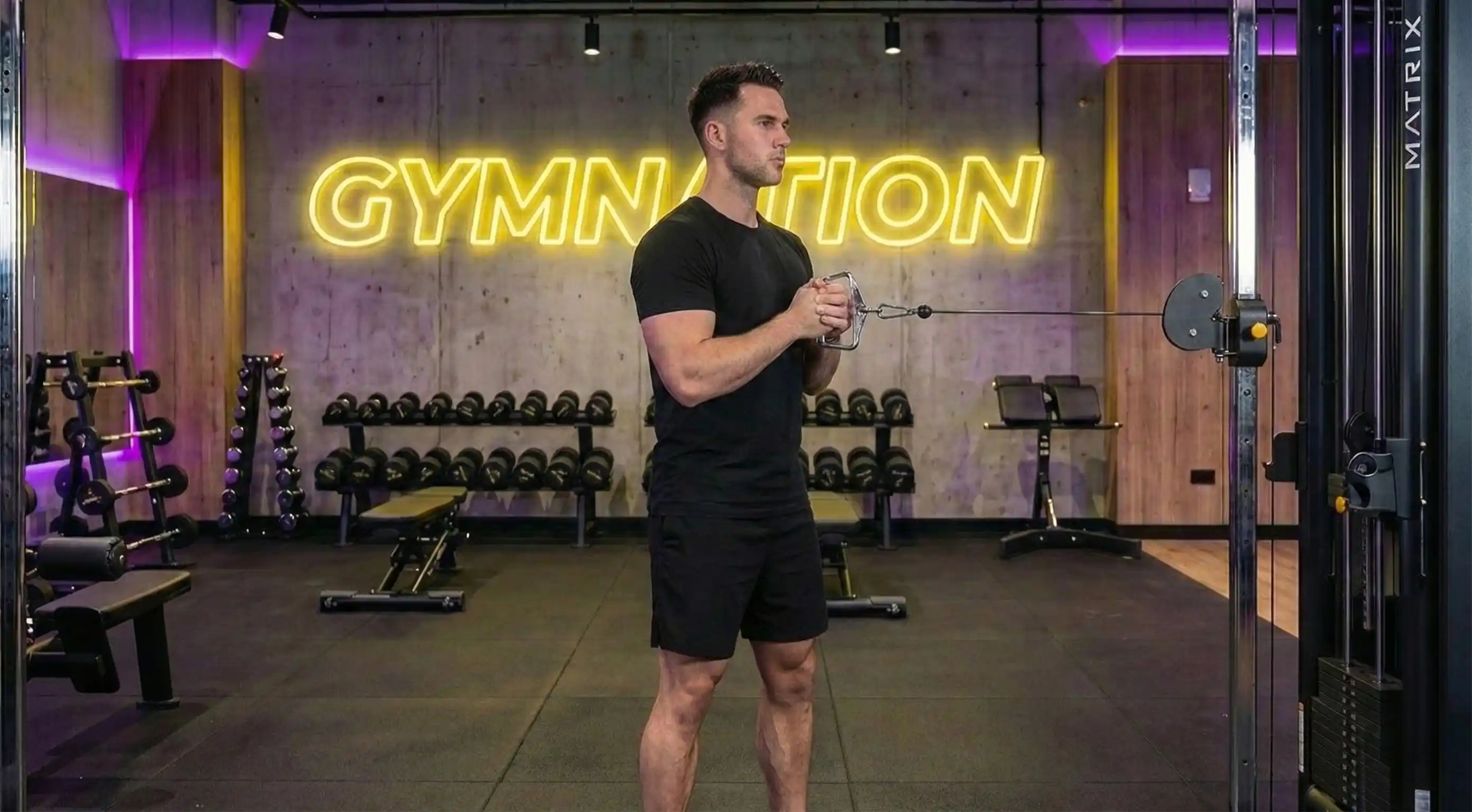
Set the handle on the cable machine at chest height, then stand sideways to the anchor point with feet shoulder width apart.
-
Bring the handle to your chest — this is your starting position.
-
Brace your core tight, squeeze the shoulder blades, and set a neutral spine before pressing.
-
Press the handle straight forward with arms straight, resisting the pull of the cable to maintain a straight line through the torso.
-
Hold this position briefly while the entire body stays stable and you continue to resist rotation.
-
Slowly return to your chest and repeat all reps before switching sides.
GymNation Tip: If your hips rotate or your torso twists, reduce the load. Proper form matters more than weight for this anti rotation core exercise.
Personal Trainer Notes:
-
Your ONLY job is to resist rotation — twisting is one of the biggest Pallof press common mistakes.
-
Keep your core tight, ribs down, and maintain a neutral spine for optimal form.
-
Maintain a strong athletic stance; avoid leaning, shifting, or losing alignment.
-
Keep the handle directly in front of the sternum with shoulder blades squeezed.
-
Beginners can use a light band; advanced athletes can add more tension from the cable stack.
-
Excellent for warm-ups before heavy compound lifts, improving stability, and reducing trunk rotation.
-
Micro-adjustments in body movement help build excellent core stability over time.
 WHATSAPP
 EMAIL
EMAIL
 SHARE VIA
Alternative Ab Exercises

Front Plank
The Front Plank strengthens the entire core, including abs, obliques, lower back, and shoulders. It builds endurance and stability, key for balance and performance in all strength exercises.

Weighted Decline Sit-up
This advanced ab move targets the entire rectus abdominis while challenging stabilisers. Adding weight increases resistance, promoting stronger and more defined abs.

Hollow Hold
The Hollow Hold is a bodyweight core exercise that builds isometric strength through the abs and hip flexors. It’s a key move for gymnasts and athletes aiming for superior core control.

Weighted Russian Twist (Legs Up)
This variation of the Russian Twist targets the obliques, rectus abdominis, and hip flexors. Elevating the legs increases core activation while the added weight boosts resistance.

Hanging Toes to Bar
The Hanging Toes to Bar develops advanced core strength, flexibility, and control. It engages abs, hip flexors, and lats, making it a full upper-body challenge.

Hanging Leg Hip Raise
The Hanging Leg Hip Raise strengthens the lower abs, hip flexors, and grip. It enhances core strength and control, improving performance in compound lifts and gymnastic movements.

Standing Wheel Rollout
The Standing Wheel Rollout is an advanced core movement that heavily activates the abs, shoulders, and lats. It builds serious core strength and stability when performed under control.

Dead Bug
The Cable Kneeling Crunch targets the entire rectus abdominis and obliques. Using the cable adds constant tension, ideal for developing core strength and definition.

Cable Kneeling Crunch
The Cable Kneeling Crunch targets the entire rectus abdominis and obliques. Using the cable adds constant tension, ideal for developing core strength and definition. Maintain control throughout to avoid pulling with momentum.
Cable Vertical Pallof Press FAQs
The cable Pallof press strengthens the core muscles by teaching your body to resist rotation. It targets the transverse abdominis, rectus abdominis, obliques, and deep stabilisers, improving posture, balance, and functional strength across all core exercises.
Stand sideways to the cable machine, brace your core, and press the handle out with arms straight while keeping your torso square. Avoid trunk rotation and maintain a neutral spine throughout the movement.
Yes. The cable vertical Pallof press increases upward tension, activating the lats and upper body while creating more tension at full extension—something horizontal pallof presses can’t match.
Standing, half kneeling Pallof press, kneeling Pallof press, band-resisted variations, and rotational or walking versions. Each adds new challenges to the entire core and enhances functional strength.
Because it’s an anti rotation exercise. The challenge comes from resisting the sideways pull of the cable, forcing constant core stabilization and tension.
It trains the rectus abdominis, transverse abdominis, obliques, glutes, shoulders, lats, and the deep stabilisers surrounding the lumbar spine—the key muscle groups for a strong core and improved performance.
Choose a load that lets you maintain a straight line without rotation. More control beats more weight every time.
Yes. Start with a resistance band or light weight, then progress to full Pallof press variations as stability improves.
2–3 times per week as part of a core workout, stability block, warm-up, or accessory training.