

Dead Bug
Dead Bug Video Guide
The dead bug exercise is a highly effective core exercise that strengthens the core muscles by training the body to stabilise while moving the limbs independently. This supine abdominal exercise targets multiple muscle groups, including the rectus abdominis, transverse abdominis, and the internal and external obliques. When the dead bug exercise works these deep abdominal muscles, it improves core strength, posture, and the ability to prevent injuries during everyday activities and athletic activities.
The dead bug teaches you to extend opposing limbs — such as the left arm with the right leg, or the right arm with the left leg — without losing tension in the core. This improves core stability, coordination, and control through the entire movement. It’s a beginner friendly movement, ideal for any core strengthening routine or fitness routine, and it supports the pelvic floor and lower spine when performed correctly. Many people use the dead bug in their workout routine as a safer alternative to sit ups due to reduced strain on the hip flexors and spine.
How to Perform the Dead Bug:
-
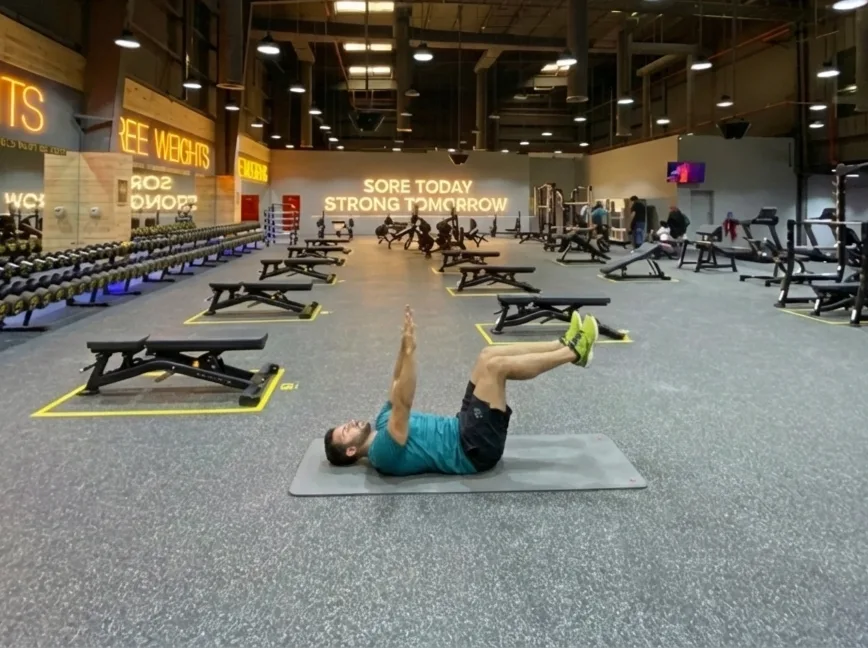
Start in the starting position by lying on a yoga mat with arms extended toward the ceiling and knees bent at a right angle above your hips. If needed, place your feet flat on the ground as a dead bug modification for extra stability.
-
Press your lower spine into the mat to activate the deep muscles of the core. This keeps your torso stable and prevents poor form or arching.
-
Slowly extend opposing limbs — for example, the opposite arm (left arm) and opposite leg (right leg) — toward the floor. Keep your core braced so the movement stays controlled.
-
Slowly lower the arm and leg until they hover above the ground, then slowly return to the start position.
-
Repeat on the opposite side (e.g., right arm and left leg) to train coordination across opposite sides of the body.
GymNation Tips:
-
Perform each rep in a slow, controlled motion, resisting momentum. Start with a few sets, then build a longer routine as your stability improves.
-
Once you’re confident, add resistance band, stability ball, ankle weights, or other advanced variations for a greater challenge. These variations ranging from simple to advanced make the dead bug scalable for different health goals.
Personal Trainer Notes:
-
Keep your lower back pressed down to protect your lower spine.
-
If you feel jabbing pains, stop immediately and reset your form.
-
Avoid the common mistake of using your arms or legs instead of your core.
-
Move slowly — moving slowly increases activation and improves coordination.
-
This is ideal for warm-ups, rehab, and building a strong core for everyday activities and athletic activities.
-
If you have concerns, a licensed physical therapist can help adjust the movement.
 WHATSAPP
 EMAIL
EMAIL
 SHARE VIA
Alternative Ab Exercises

Front Plank
The Front Plank strengthens the entire core, including abs, obliques, lower back, and shoulders. It builds endurance and stability, key for balance and performance in all strength exercises.

Standing Wheel Rollout
The Standing Wheel Rollout is an advanced core movement that heavily activates the abs, shoulders, and lats. It builds serious core strength and stability when performed under control.

Weighted Decline Sit-up
This advanced ab move targets the entire rectus abdominis while challenging stabilisers. Adding weight increases resistance, promoting stronger and more defined abs.

Hanging Leg Hip Raise
The Hanging Leg Hip Raise strengthens the lower abs, hip flexors, and grip. It enhances core strength and control, improving performance in compound lifts and gymnastic movements.

Hollow Hold
The Hollow Hold is a bodyweight core exercise that builds isometric strength through the abs and hip flexors. It’s a key move for gymnasts and athletes aiming for superior core control.

Cable Vertical Pallof Press
The Cable Vertical Pallof Press strengthens the deep core stabilisers, including obliques and transverse abdominis. It’s excellent for anti-rotation strength and stability under tension.

Hanging Toes to Bar
The Hanging Toes to Bar develops advanced core strength, flexibility, and control. It engages abs, hip flexors, and lats, making it a full upper-body challenge.

Cable Kneeling Crunch
The Cable Kneeling Crunch targets the entire rectus abdominis and obliques. Using the cable adds constant tension, ideal for developing core strength and definition. Maintain control throughout to avoid pulling with momentum.

Weighted Russian Twist (Legs Up)
This variation of the Russian Twist targets the obliques, rectus abdominis, and hip flexors. Elevating the legs increases core activation while the added weight boosts resistance.
Dead Bug FAQs
It improves core strength, core stability, and coordination while strengthening abdominal muscles like the rectus abdominis, transverse abdominis, and external obliques. These benefits of the dead bug translate to safer lifting and better performance across your exercise routine.
No single movement burns fat. However, dead bugs tone the core muscles so they become more visible when body fat decreases.
Often yes — dead bugs work deep abdominal muscles without straining the spine or hip flexors, unlike many crunches and sit ups.
The exercise targets multiple muscle groups:
-
rectus abdominis
-
transverse abdominis
-
internal and external obliques
-
stabilisers around the hip flexors, spine, and pelvis
Use resistance band variations, a stability ball, free weights, or ankle weights for more advanced variations once your form improves.
Yes. It is a beginner friendly movement when performed correctly and is commonly recommended by a physical therapist.
Arching the lower back, lowering the limbs too far, moving too quickly, or losing tension in the core. Maintaining proper form keeps the abs working through the entire range.