
Front Plank
Front Plank Video Guide
The front plank is a staple core exercise that strengthens the core muscles, abdominal muscles, oblique muscles, rectus abdominis, transversus abdominis, and the deeper stabilisers that support a neutral spine. This plank exercise trains your entire midsection to hold a straight line from head to heels while resisting movement. The position closely mirrors the push-up position, high plank, forearm plank, straight arm plank, and many plank variations used in an effective workout routine, exercise routine, or rehab plan recommended by a physical therapist.
Because the front plank is an isometric exercise, it builds core endurance, core strength, and core stability without excessive pressure on the lower back. The exercise recruits multiple muscle groups at once, including the gluteus maximus, shoulders, upper body, lower body, and pelvic floor, making it a full body exercise that fits into nearly all strength exercises, athletic sessions, and full body workouts. Many athletes use the front plank as a foundational movement before progressing to side planks, reverse plank, incline plank, and other plank variations or plank exercises designed to challenge stability and coordination.
How to Perform the Front Plank:
-
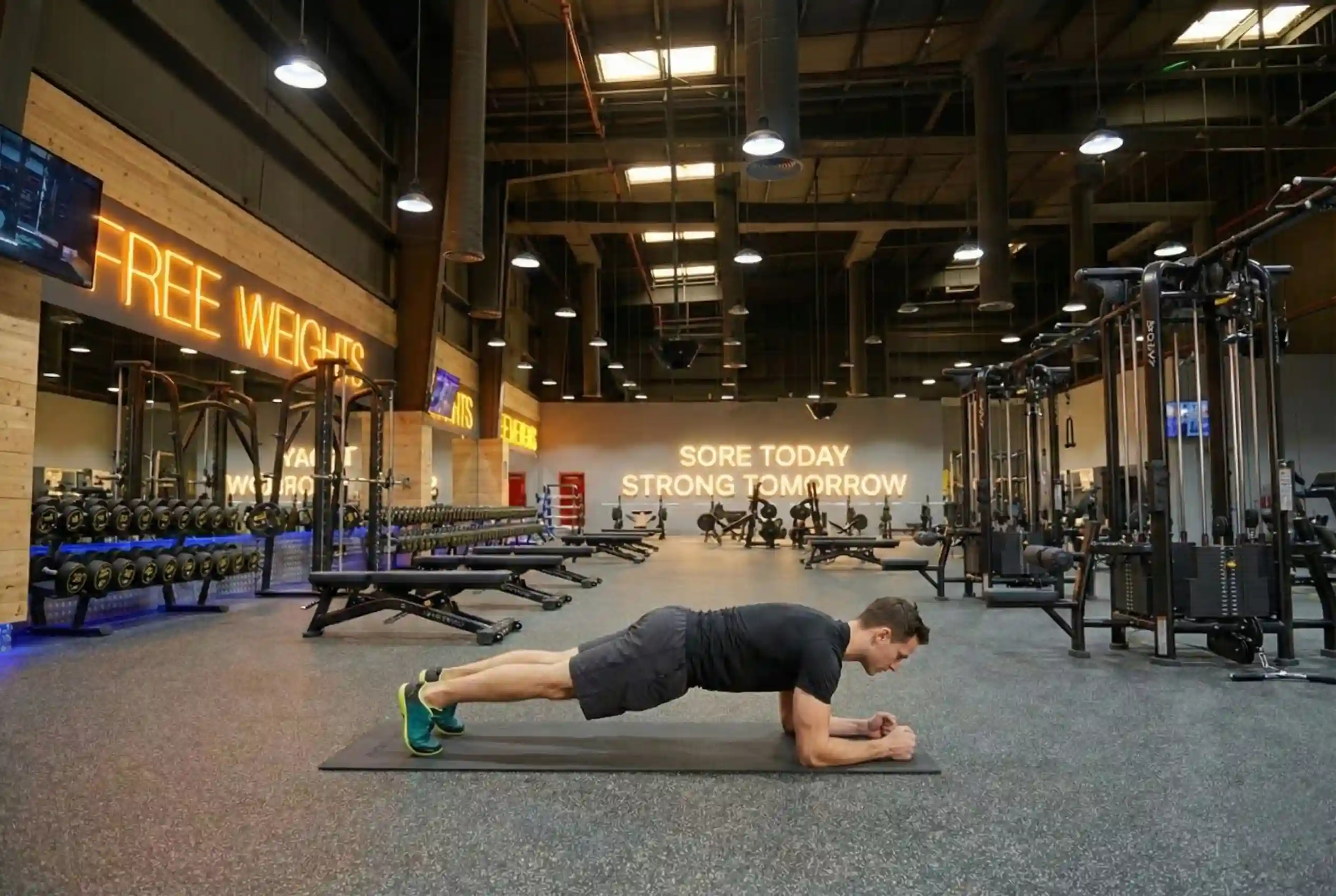
Begin in the starting position face down on a yoga or exercise mat. Set up in a stable forearm plank position (elbows under shoulders) or a straight arm plank with arms straight and hands directly under your shoulders.
-
Extend your legs back so the left foot and right foot are aligned and your body forms a long straight line. Keep your hips lifted, shoulders stacked, and spine in a neutral position.
-
Engage the core muscles, pulling your abdominal wall tight and bracing the deep core. Keep your torso still — this is the key to proper muscle activation.
-
Maintain a neutral spine, avoiding sagging, bending at the knees, or lifting your hips too high.
-
Hold this position while breathing steadily, maintaining stability through your arms, legs, and centre.
-
When your form breaks, slowly lower the knees to exit the plank correctly.
GymNation Tip: This plank position teaches your body to maintain stability during movement, improving balance, strength, and posture in both everyday activities and athletic activities.
Personal Trainer Notes:
-
Keep the core tight throughout — never lose tension.
-
Maintain proper form by keeping your spine neutral and your body forming a straight line.
-
If the standard plank is too challenging, try a modified plank, knee plank, or incline plank on an elevated surface.
-
Avoid poor form such as sagging hips, flared ribs, or neck strain.
-
Imagine pulling the belly button toward the spine for better stabilisation.
-
If you feel low-back discomfort or sharp pains, stop and consult a physical therapist.
 WHATSAPP
 EMAIL
EMAIL
 SHARE VIA
Alternative Ab Exercises

Hanging Toes to Bar
The Hanging Toes to Bar develops advanced core strength, flexibility, and control. It engages abs, hip flexors, and lats, making it a full upper-body challenge.

Hanging Leg Hip Raise
The Hanging Leg Hip Raise strengthens the lower abs, hip flexors, and grip. It enhances core strength and control, improving performance in compound lifts and gymnastic movements.

Cable Vertical Pallof Press
The Cable Vertical Pallof Press strengthens the deep core stabilisers, including obliques and transverse abdominis. It’s excellent for anti-rotation strength and stability under tension.

Dead Bug
The Cable Kneeling Crunch targets the entire rectus abdominis and obliques. Using the cable adds constant tension, ideal for developing core strength and definition.

Weighted Decline Sit-up
This advanced ab move targets the entire rectus abdominis while challenging stabilisers. Adding weight increases resistance, promoting stronger and more defined abs.

Cable Kneeling Crunch
The Cable Kneeling Crunch targets the entire rectus abdominis and obliques. Using the cable adds constant tension, ideal for developing core strength and definition. Maintain control throughout to avoid pulling with momentum.

Hollow Hold
The Hollow Hold is a bodyweight core exercise that builds isometric strength through the abs and hip flexors. It’s a key move for gymnasts and athletes aiming for superior core control.

Weighted Russian Twist (Legs Up)
This variation of the Russian Twist targets the obliques, rectus abdominis, and hip flexors. Elevating the legs increases core activation while the added weight boosts resistance.

Standing Wheel Rollout
The Standing Wheel Rollout is an advanced core movement that heavily activates the abs, shoulders, and lats. It builds serious core strength and stability when performed under control.
Front Plank FAQs
The front plank is a core exercise where you hold a stable plank position on your forearms or hands, forming a straight line from head to heels. It activates the core muscles, including the rectus abdominis, oblique muscles, and deep core muscles.
Most people start with 20–30 seconds and progress to longer holds. Quality matters more than time — stop as soon as you lose proper form.
Planks work the rectus abdominis, oblique muscles, transverse abdominis, pelvic floor, glutes, shoulders, upper body, lower body, and stabilisers along the spine. They are among the best core exercises for total muscle activation.
Options include the side plank, reverse plank, high plank, straight arm plank, knee plank, incline plank, and planks with opposite arm or leg lifts. These plank variations challenge different muscle groups.
Yes — it works the whole body and enhances core stability, coordination, and posture. It fits perfectly in any exercise program or workout routine.
Maintain a neutral spine, squeeze the glutes, tighten the core, and keep shoulders stacked. Stability is key — don’t allow shifting of the left hip, right hip, or ribs.
For most people, yes. Planks reduce strain on the neck and spine and train deeper stabilisers that support mental health, mobility, and injury prevention.
Absolutely. Start with modified plank variations or shorter holds. Add side planks, reverse plank, or accessory stability work as strength improves.